Breaking Free from Spiritual Strongholds through Faith
Spiritual Strongholds and the Table Christ Sets
The Empty Chair
You know that feeling when your apartment is dead quiet except for the hum of the fridge and the buzz of your iPhone screen lighting up with notifications that are somehow loud and empty at the same time. You heat up Trader Joe’s orange chicken, stand at the counter, and scroll Slack messages from coworkers in three time zones while rain taps the window. The chair across from you stays pushed in. No eye contact. No laughter. Just blue light on your face and that weird ache in your chest that no DoorDash order can fill.
That ache is not random. It is a hunger deeper than calories. Your body wants food, sure, but your soul wants presence. Sin loves to weaponize that gap. A spiritual stronghold often starts there, not with cinematic darkness, but with repeated lies downloaded into your inner world: you are safer alone, nobody gets you, keep your mask on, stay hidden, stay efficient, don’t let anyone close enough to ask real questions.
Paul writes in 2 Corinthians 10:4-5, “For the weapons of our warfare are not of the flesh but have divine power to destroy strongholds. We destroy arguments and every lofty opinion raised against the knowledge of God, and take every thought captive to obey Christ.” Think of it like this app running in the background. A stronghold is not merely a bad habit. It is a fortified pattern of deception. In the ancient world, a stronghold was a defensive fortress built on high ground. In Paul’s argument, the fortress is mental, moral, spiritual. It is an algorithm of lies reinforced by repetition.
You can see it in modern life with painful clarity. A remote worker in a San Jose studio apartment keeps cameras off on every Zoom call, says “all good” in every check-in, and then spends six hours on Reddit, TikTok, and Discord numbing the static in his head. A college student eats fries alone outside the student union after seeing Instagram stories of a dinner she was not invited to. A married couple sits ten feet apart on the couch, each wearing AirPods, each feeding different appetites, while resentment compiles quietly in the background.
Spiritual strongholds feed on isolation because lies grow fastest where truth is never spoken aloud. The empty chair at the table becomes a symbol. Not just missing company. Missing communion. Missing the kind of presence where false narratives get debugged and grace gets a seat.
Pull up a chair:
The Scandalous Dinner Guest
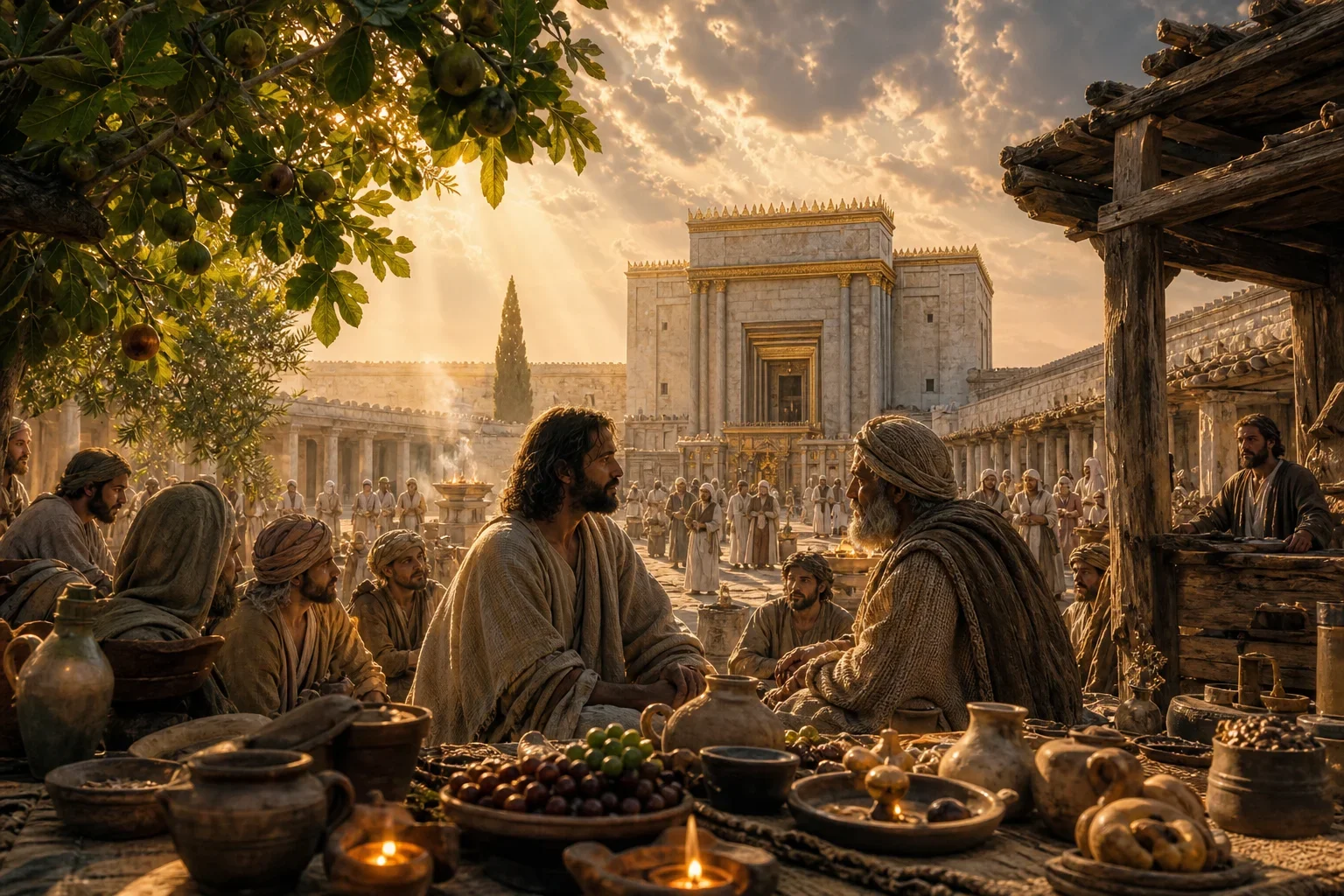
Jesus stepped right into that ache, and he did it at tables. Not by building a brand, not by curating a clean social feed, but by taking meals with the wrong people in the wrong neighborhoods at the wrong times according to respectable religion. In first-century Judaism, table fellowship carried social code, purity code, honor code. Who you ate with said who you were. Jesus intentionally crashed that operating system.
Luke 5:29-32 records one of those collisions: “And Levi made him a great feast in his house, and there was a large company of tax collectors and others reclining at table with them. And the Pharisees and their scribes grumbled at his disciples, saying, ‘Why do you eat and drink with tax collectors and sinners?’ And Jesus answered them, ‘Those who are well have no need of a physician, but those who are sick. I have not come to call the righteous but sinners to repentance.’” That is table theology with teeth. Jesus is not endorsing sin. He is storming the fortress where shame says, You are too contaminated to come near God.
Think of Levi’s dining room with actual texture. Oil lamps flicker against plaster walls. Sand sticks to ankles. Men with reputations nobody wanted sit shoulder to shoulder, startled that a rabbi is not flinching at their presence. Outside, religious critics stand in the street heat, arms crossed, faces tight, running their purity firewall. Jesus walks through it anyway. He treats the table as a frontline assault on spiritual strongholds.
One stronghold says holiness means distance from messy people. Jesus debugged that. Another says sinners must self-repair before coming close. Jesus smashed that too. He came near with truth and mercy in the same packet. If/then: if the lie says grace is for polished people, then the table of Christ proves grace targets the spiritually bankrupt first.
You see the same pattern in the feeding of the multitudes. Mark 6:41 says, “And taking the five loaves and the two fish he looked up to heaven and said a blessing and broke the loaves and gave them to the disciples to set before the people. And he divided the two fish among them all.” This is not only a miracle of provision. It is kingdom reordering. In a desolate place, where scarcity should have ruled, Jesus creates abundance and seating and distribution. He organizes hungry bodies into receiving communities. No one earns bread. They receive it.
That matters for spiritual strongholds because many of them are scarcity scripts. There is not enough love. Not enough grace. Not enough room. Not enough future after what you did. Jesus says, sit down on the grass. Open your hands. The kingdom does not run on your anxious self-supply.
Then you get the Last Supper, where betrayal is already in the room. That detail wrecks me every time. Jesus knows Judas is there. He knows Peter will fold under pressure. He knows the whole squad is about to scatter harder than a raid group after the boss one-shots the tank 🔥. Yet he still sets bread and cup before them. Luke 22:19-20 says, “And he took bread, and when he had given thanks, he broke it and gave it to them, saying, ‘This is my body, which is given for you. Do this in remembrance of me.’ And likewise the cup after they had eaten, saying, ‘This cup that is poured out for you is the new covenant in my blood.’”
That is scandalous grace. At the table, Jesus confronts strongholds not merely by argument but by embodied covenant. He does not wait for people to become flawless. He gives himself as the feast that frees them.
Pass the bread:
Theology of the Table
If you want to debug spiritual strongholds at a deeper level, the table matters because Scripture treats eating as covenantal, not casual. Meals in the Bible often mark allegiance, peace, memory, and identity. You are not just consuming nutrients. You are participating in a story. That is why idolatry and communion both use table imagery. The table is an interface of belonging.
Psalm 23:5 says, “You prepare a table before me in the presence of my enemies; you anoint my head with oil; my cup overflows.” Notice the setting. The table is not prepared after every enemy is deleted from the map. It is prepared in their presence. That means God’s feast is not escapism. It is defiant communion in contested space. A stronghold says, You can rest only when all threats are gone. God says, Sit down. Receive. I can sustain you in the middle of conflict.
Historically, the Lord’s Supper carried this force in a culture shaped by temple meals, patronage systems, and status hierarchy. Paul’s correction in 1 Corinthians 11 hits hard because some believers were reproducing social divisions at the very meal meant to announce union with Christ. The table of Jesus is not a private spiritual snack. It is covenant participation in the crucified and risen Lord, which means every rival identity gets challenged there.
1 Corinthians 10:16 says, “The cup of blessing that we bless, is it not a participation in the blood of Christ? The bread that we break, is it not a participation in the body of Christ?” Participation is the key word. Communion is not bare memory in the thin sense. It is a God-given means by which Christ’s people receive and proclaim his saving work. Think of it as God’s algorithm for life interrupting all counterfeit scripts. At the table, Jesus reassigns your primary identity: not addict, not failure, not achiever, not outsider, but redeemed in him.
This also pushes forward to the feast imagery of the kingdom. Isaiah 25 and Revelation 19 frame salvation with banquet language because redemption is not less than personal forgiveness, but it is bigger. It includes restored creation, restored people, restored joy. The divine source code has always been moving toward a feast, not a bunker. Strongholds isolate. The kingdom gathers.
So when you come to Christ’s table, you are doing spiritual warfare in a deeply embodied way. Your hands receive bread. Your mouth receives cup. Your body rehearses a truth your anxieties resist. Jesus is enough. His sacrifice is complete. His covenant is secure. His people are one. Time to upgrade your faith OS: the table is where grace gets past abstraction and into muscle memory.
The table is set:
Setting the Table
Now bring this into your actual Tuesday night. Spiritual strongholds do not only crack in sermon notes or podcast clips. They crack when the gospel gets embodied in ordinary rooms with actual people, actual food, actual conversation, and actual patience. I am talking about a folding table in a Fremont apartment, steam rising off bulgogi tacos, kids dropping forks, someone laughing too hard, someone else tearing up halfway through dessert because they have not been asked a real question in months.
Romans 12:13 says, “Contribute to the needs of the saints and seek to show hospitality.” In the first-century setting, this carried risk, inconvenience, and cost. In your setting, it still does. You have calendars synced across Google, iCloud, and Outlook, and everybody is “crazy busy.” Yet busyness can become a socially acceptable stronghold. It fortifies self-protection. It lets you keep life optimized and untouched.
So set the table on purpose. Invite the new engineer on your team who moved here from Hyderabad and has spent three weekends alone in corporate housing. Text the single mom from church who slips out fast after the service because wrangling two exhausted kids feels brutal. Ask the college student who always says “I’m good” while posting 2 a.m. BeReal photos from the library. This is not performance. This is resistance against lies that say nobody has room for me.
And keep it concrete. Put your phone in another room. Light the table, even if it is just a cheap IKEA lamp with warm bulbs instead of overhead glare. Warm tortillas. Brew jasmine tea. Let silence happen without panic. Ask one layer deeper than “How’s work?” Ask, “Where have you felt spiritually pinned lately?” or “What lie keeps replaying in your head?” Let Scripture answer with precision, not clichés.
Church life can do this too. Potlucks, post-service lunches, campus dinners, game nights with actual food on the counter, these are not side quests. They can become places where lonely people get reintroduced to the nearness of Christ through his people. Think of it like this app: your table can become a grace interface where shame loses bandwidth and truth gets downloaded slowly, one conversation at a time.
Pull up a chair:
Foretaste of the Feast
The Christian table always points ahead. Every faithful table on earth is a preview render, not the full release. You taste something real now, but not complete yet. That future angle matters when you are fighting spiritual strongholds because many lies gain power from short horizons. They whisper that your grief is permanent, your patterns are final, your healing is impossible, your loneliness is the truest thing about you.
Revelation 19:9 answers with a better word: “Blessed are those who are invited to the marriage supper of the Lamb.” That is not fantasy language. It is covenant destiny. The end of the story is not disembodied drift on clouds. It is celebratory communion with the risen Christ in a renewed creation. The wedding feast means evil is judged, death is broken, and the people of God are gathered with joy that no algorithm can manipulate and no empire can throttle.
Jesus hinted at this when he spoke of new wine in the kingdom. At the Last Supper, he framed the cup with future hope. The meal was not only memory of sacrifice. It was anticipation of completion. Every time believers come to the Lord’s Table, they proclaim a past event and a coming victory. That double horizon is huge. It means your battle with strongholds is not a loop with no exit. The end state has already been promised.
Picture a wedding reception under strings of warm lights after the sun drops behind the hills, glasses catching gold reflections, music swelling, people embracing after years of ache. Now upgrade that image beyond anything Pixar, Marvel, or Denis Villeneuve could render. No hidden shame. No fractured loyalties. No envy scrolling through somebody else’s highlight reel. No empty chair that signals rejection. Only redeemed presence under the reign of Christ.
So set your table now as an act of hope. Pray over takeout containers. Pour sparkling water into mismatched glasses. Make room for the awkward person, the grieving person, the skeptical person, the person who has not quite figured out how to pray without feeling weird. You are not creating the kingdom by your effort. You are bearing witness to it. Small tables can become prophetic signs. They announce that the fortress of lies will not stand forever, because the King is preparing a feast no darkness can cancel.
Invitation to feast
You can start tonight. Clear a table. Wipe off the crumbs. Set one extra place. Send the text you have been postponing. If spiritual strongholds are fortified lies, then one way Christ tears them down is by bringing people into truthful, grace-soaked presence around what he provides. Not flashy. Not complicated. Real.
And come to Jesus yourself. Bring the empty places, the compulsive patterns, the polished religious mask, the shame you keep alt-tabbing away from. He is still the scandalous dinner guest who becomes the host. He still gives himself as bread for the hungry and covenant cup for the thirsty.
Here is a simple feast prayer: Lord Jesus, set your table in the places where lies have built walls in me. Feed me with your truth. Rewire my loves. Make my home a place where your grace has a chair and your word has a voice. And make me hungry for the marriage supper of the Lamb. Amen.
Relational: Who in your life exemplifies this truth about Spiritual Strongholds, and what would it look like to sit with that person long enough for honest conversation to replace polished updates?
Action: Who will you invite to your table in the next seven days, and what specific lie or stronghold might that simple act begin to confront?
Contemplative: Breathe with this truth: Christ prepares a table in the presence of your enemies. Where do you feel resistance to sitting down and receiving what he gives?
Continue Your Bible Study
Explore more lessons and deepen your understanding of scripture
View All Lessons Ask AI a Question