Christ Upholds All Things by His Powerful Word

Upholds All Things
Some truths in Scripture land on you all at once, almost with the force of a storm front rolling across dark water, and this is one of them. You are trying to pay rent, answer that awkward text from your brother, sit in a waiting room with fluorescent lights buzzing overhead, and keep your mind from spiraling when the bank app opens and the numbers stare back at you. At the same time, you hear Christians speak about God sustaining the world, and maybe part of you nods while another part quietly wonders what that means when your actual Tuesday feels fragile. That tension is real, and if you have ever felt it, you are not weak or faithless; you are awake to the weight of being human.
Hebrews gives language for that weight and for the glory above it:
The Son is the radiance of God’s glory and the exact representation of His nature, and upholds all things by the word of His power. After He had provided purification for sins, He sat down at the right hand of the Majesty on high.That sentence does not speak in tiny categories. It reaches from the identity of Christ to the endurance of creation to the cleansing of sinners, all in one breathtaking sweep. Picture yourself walking through ancient corridors lined with imperial statues, every ruler claiming power, every empire promising stability, and then hearing that above Caesar, above markets, above weather, above your pulse itself, the Son upholds all things.
The Crossroads Moment
You can picture the scene because you may have lived some version of it. A woman in Phoenix sits in her Honda Civic outside a Fry’s grocery store at 6:40 p.m., the steering wheel warm from desert heat, her phone glowing with a calendar alert for a pediatric appointment she cannot miss and a second alert warning that her credit card payment is due. Her husband has been sleeping on the couch after three weeks of arguments over money and over his mother moving in after surgery. Their pastor has asked whether they are willing to meet for counseling, her boss has hinted that missing one more Saturday shift could cost her hours, and her teenage son has started going silent at dinner. You feel the pressure from every side because none of these pieces stand alone.
Now widen the frame. A city bus driver in Chicago is trying to care for an aging father with early dementia while navigating traffic on Western Avenue, listening to riders argue near the back, and swallowing anxiety over a biopsy scheduled Friday morning. A college student at a state university stares at a dorm ceiling at 2:13 a.m., wondering whether to break off a relationship that has become manipulative, even though loneliness already feels heavy enough to crush the chest. A middle school teacher in Atlanta, red-eyed after grading papers and dealing with a parent complaint, wonders whether staying in education is faithfulness or fear. These are not neat dilemmas with one shiny answer.
When Scripture says Christ upholds all things, your mind can rush toward abstraction, but real life keeps dragging the doctrine into grocery aisles, congested freeways, and tense kitchens where nobody quite knows who should speak first. I remember being twenty and close to losing faith in college, sitting under harsh library lights with archaeology notes spread across the table, asking whether Christianity could bear the weight of history and pain at the same time. What steadied me was not a sentimental slogan. It was the growing realization that the risen Jesus is not merely giving advice from a distance; He is the living Lord whose power holds together every breath, every empire, every atom, and every battered believer who thinks they are one bad week from collapse.
That is the crossroads. You need wisdom for decisions, yes, but beneath the decision sits a deeper question: if Christ truly upholds all things, what kind of life emerges from that reality when your world feels as shaky as scaffolding in a windstorm?
Another voice speaks:
Voices from the Cloud
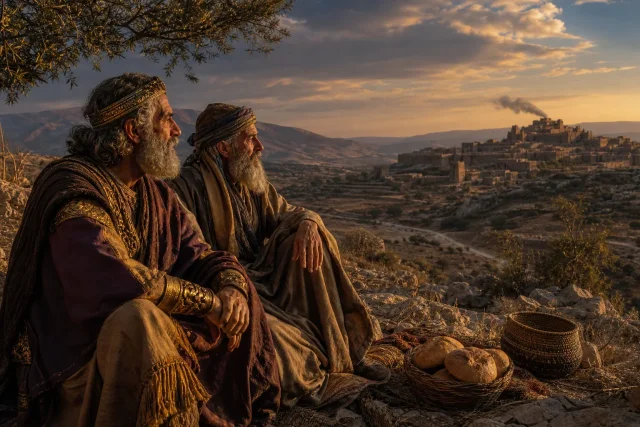
The first voice comes from the wilderness generation through Moses, and it carries the dust of the desert with it. In Deuteronomy 8:3, Moses tells Israel,
He humbled you and let you be hungry, and fed you with manna, which you did not know, nor did your fathers know, that He might make you know that man does not live by bread alone, but man lives by everything that proceeds out of the mouth of the Lord.Bread matters. Groceries matter. Bodies matter. Yet the passage presses deeper, insisting that beneath visible provision stands the speaking God. Hebrews 1:3 takes that same reality and places it in the Son: the One whose powerful word sustains all things is not detached from daily bread; He is the reason daily bread can nourish at all.
The second voice comes from the Psalms, and history comes alive when you realize these songs were carried by people who knew invasion, grief, harvest, drought, temple worship, and exile. Psalm 104:27-30 says,
They all wait for You, that You may give them their food in due season. You give to them, they gather it up. You open Your hand, they are satisfied with good. You hide Your face, they are troubled. You take away their breath, they die and return to their dust. You send forth Your Spirit, they are created. You renew the face of the ground.That is creaturely dependence in full color. Ancient shepherds, sea creatures, laborers, kings, all waiting. The stones cry out here in their own way: creation is not self-sustaining. It is upheld.
The third voice is Jesus Himself in a scene so cinematic you can almost hear the wind snapping against fabric. In Matthew 6:26, while speaking to anxious people under open sky, He says,
Look at the birds of the air, that they do not sow, neither do they reap, nor gather into barns; yet your heavenly Father feeds them. Are you not worth much more than they?Jesus does not mock anxious hearts. He redirects them. Picture sparrows darting above Galilean fields, quick and fragile, and Christ saying that the Father’s care reaches there. The One who upholds all things is not merely managing cosmic machinery. He attends to what seems small, including you when your thoughts race in traffic or in the checkout line.
The fourth voice comes from Paul, writing to a church surrounded by the swagger of Roman power and the seduction of self-sufficiency. Acts 17:28 records his words:
for in Him we live and move and have our being, as some of your own poets have said, ‘For we are also His offspring.’That line lands with force in any century. Your lungs rise because He grants breath. Your body moves because His sustaining will has not withdrawn. When Hebrews says the Son upholds all things by His powerful word, Paul gives the lived implication: your existence itself is contingent, borrowed, upheld every second.
I think about a museum visit during college, standing in front of cracked clay tablets from long-fallen kingdoms. Their rulers once sounded permanent. Their inscriptions boasted. Their armies marched. Now they sit behind glass under soft bulbs while Christ reigns still. That perspective does not erase your present pain, but it changes scale. The sustaining power of the Son is not a decorative doctrine for theology shelves. It is the deepest fact in the room when a marriage strains, when bloodwork comes back abnormal, when you are deciding whether to stay, go, speak, wait, repent, or trust.
Consider also:
Wisdom Across Cultures
The early church spoke about Christ’s sustaining power with a sense of awe sharpened by persecution. Athanasius, writing in a world where believers could lose status, safety, and even life, spoke of the Word of God as the One who orders and holds creation together. He was not writing from a climate-controlled office with a latte on the desk. He lived amid controversy and imperial pressure, yet he insisted that the Word who became flesh did not stop governing the universe while lying in a manger or hanging on a cross. That vision matters because you may act as though Jesus can either save your soul or carry your world, but not both. Historic Christian witness refuses that split.
Another voice rises from Africa, Asia, and Latin America, where many believers read passages about God’s sustaining care with fewer illusions about control. I have sat with brothers in a cramped apartment Bible study who worked warehouse shifts, sent money to relatives overseas through Western Union, and prayed over family members facing cartel violence back home. When they spoke about Christ upholding all things, they did not mean life felt easy. They meant the living Jesus remained Lord when the ground under their plans kept moving. There is a kind of wisdom born in communities that cannot pretend self-sufficiency.
Church history also gives you the witness of ordinary saints whose names never made textbooks. Think of mothers in plague years, pastors in war zones, and believers hiding handwritten Scripture pages because owning a Bible could cost them dearly. Their lives echo a truth the modern West often forgets: stability is not the same as sovereignty. A stocked pantry, a strong retirement account, and a smooth commute on I-35 can create the illusion that life is held together by systems, but one diagnosis, one layoff email, one hurricane warning on your phone can strip that illusion fast. The archaeological evidence tells us that every civilization leaves ruins. Christ alone leaves an empty tomb.
Even the language of worship across cultures reinforces this. Korean dawn prayer meetings, Nigerian praise services that shake concrete floors, house churches in restricted nations, and quiet hospital chapels in American cities all confess in different accents that the world is not self-running. I love that. Picture a mosaic made from thousands of stones, different colors and textures, each carrying one confession: the Son still reigns. You are not asked to manufacture ultimate security. You are invited to live beneath the One who already bears the weight of the cosmos and the weight of your story.
From a different angle:
The Wisdom Tapestry
When you weave these voices together, a rich pattern emerges. Moses reminds you that life depends on the word of God more deeply than on bread. The psalmist places all creatures in a posture of waiting. Jesus turns anxious eyes toward the Father’s care in creation. Paul declares that every movement of your existence occurs in God. Hebrews gathers those strands and centers them in Christ, the Son who is the radiance of God’s glory and who upholds all things by the word of His power. This is not a loose collection of comforting thoughts. It is a unified biblical vision.
That vision guards you from two opposite mistakes. One mistake is panic, where you live as though everything depends on your grip, your timing, your spreadsheet, your emotional stamina, your ability to keep every relational plate spinning without a crash. The other mistake is passivity, where “God is in control” becomes an excuse for avoidance, silence, or laziness. Biblical wisdom rejects both. If Christ upholds all things, then your work matters because you serve within His upheld world, and your work is limited because you are not the one holding it all together.
Picture a suspension bridge at dusk, cables under immense tension, cars moving across while river water below reflects orange city light. Most drivers never think about the hidden forces carrying that weight. In a similar way, you often move through ordinary routines without seeing the sustaining hand of Christ. You answer emails, pick up prescriptions at CVS, sit through a tense HOA meeting, wave to a neighbor dragging in trash bins before rain hits, and all the while your existence is upheld by Another. History comes alive when we realize biblical theology is not detached from lived reality; it is the hidden architecture beneath it.
There is also a gospel center here that you cannot miss. Hebrews 1:3 does not stop with cosmic sustaining power. It says,
After He had provided purification for sins, He sat down at the right hand of the Majesty on high.The One who sustains galaxies is the same One who deals with guilt. That means your deepest crisis is not merely external instability but alienation from God, and Christ addresses both lordship and redemption. He does not only keep the universe from flying apart; He reconciles sinners who already have.
So a wise framework begins to form. Ask first: what part of this situation actually belongs to my responsibility? Ask next: where have I quietly tried to play savior, provider, controller, or judge? Ask also: what does faithfulness look like inside a world Christ already sustains? That may mean making the doctor appointment, apologizing first, setting a boundary, taking the extra shift for a season, or refusing the promotion that would devour your family life. Wisdom is not grabbing control. Wisdom is responsive obedience under the upheld order of Christ.
I think back to that season when my faith nearly collapsed. What pulled me back was not flashy certainty. It was the cumulative witness of history, Scripture, resurrection evidence, and the strange steadiness of Christ through people who had every worldly reason to quit. The Son who upholds all things had not dropped me, even while I was doubting whether He was there.
Another voice speaks:
Walking in Wisdom
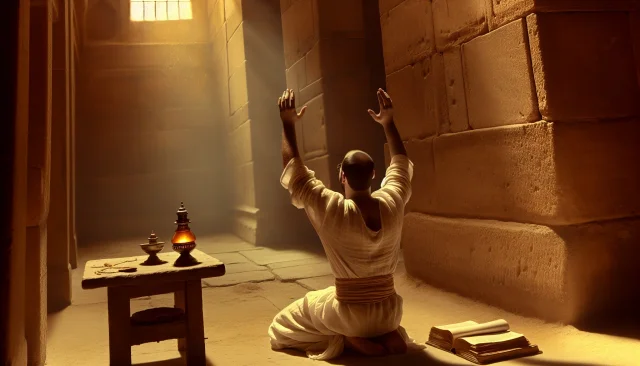
If this truth is real, it has to enter ordinary rhythms. Start your day with a short, honest prayer before your feet hit the floor: Lord Jesus, You uphold all things today, and I am not the exception. That is not a magic formula. It is a posture reset. When your phone starts firing notifications from Slack, school apps, weather alerts, and family group chats, you are already being discipled into urgency. You need a stronger word shaping your reflexes.
Practice naming what is upheld by Christ and what is not assigned to you. At the grocery store, while comparing prices on eggs and bread, you can quietly say, “My family is my stewardship; the future is not my throne.” In traffic, when someone cuts across three lanes with zero turn signal energy, white-knuckling the wheel will not sustain the universe. In a neighborhood conflict over barking dogs, parking spaces, or a fence line six inches off the property mark, you can speak truthfully without acting as though the fate of creation hangs on your argument. That is theology with work boots on.
Build accountability with people who can tell when your trust has curdled into control. A spouse, mentor, pastor, or mature friend can ask, “Where are you carrying weight Christ never asked you to carry?” I ask young men that question a lot. Sometimes the answer is hidden under overwork. Sometimes it hides under constant phone scrolling, as if enough information can produce sovereignty. Sometimes it takes the shape of rescuing everyone else because facing your own dependence feels terrifying.
Make room for embodied reminders. Step outside at night and look up. Picture yourself walking through ancient Judean hills where the same stars burn above shepherd country, and remember that the Lord who called them into place has not misplaced your life. Read Hebrews 1:3 aloud. Read Psalm 104 aloud. Sit with Matthew 6 until your pulse slows a notch. If you are in a hard season, write one sentence on an index card and tape it near your dashboard or coffee maker: Christ upholds all things by the word of His power.
Then respond with concrete trust. Pay the bill you can pay. Make the call you have been avoiding. Ask forgiveness where you have sinned. Rest when your body is warning you. Give generously even when fear whispers scarcity. Cast your anxiety on Him in prayer, not because your problems are tiny, but because He is not. Wisdom begins here: not with pretending life is manageable, but with bowing before the Son who truly sustains it.
This is your invitation to the path of wisdom. Bring Him the tangled decision, the strained relationship, the health concern, the unpaid balance, the quiet dread you hide behind jokes and productivity. Take one practical first step today by naming, in prayer, one burden you have been carrying as though you were the one holding up the world. Then pray with open hands: Lord Jesus, radiant Son of God, uphold my wavering heart within Your upheld world. Teach me faithful action, humble dependence, and deep rest beneath Your powerful word. Amen.
Reflection Questions
Introspective: What parts of your story reveal that you have been trying to hold together what only Christ can truly uphold?
Theological: How does the picture of Jesus in Hebrews 1:3 reshape your view of God’s power, care, and nearness in ordinary life?
Action: What is one specific burden from your week—at work, at home, in your finances, or in your health—that you will consciously place before Christ in prayer today?
Continue Your Bible Study
Explore more lessons and deepen your understanding of scripture
View All Lessons Ask AI a Question