Walking with the Father of Lights in Faith

Father of Lights
Expose the empire
Picture yourself under the cold glow of a phone screen at 6:12 a.m., before your feet hit the floor, before coffee, before prayer, before your own breathing slows. Notifications flicker, headlines pulse, bank balances stare back, and your heart starts taking attendance: who noticed me, who forgot me, what broke overnight, what bill waits, what diagnosis still hangs in the air, what relationship remains tense. We live in an empire of shifting lights, bright one second and gone the next, where approval rises and falls faster than stock tickers on a CNBC screen.
The pattern is powerful because it trains you to trust whatever shines most urgently. A promotion glitters, a flawless family photo glitters, a perfectly curated kitchen remodel glitters, a political tribe glitters, a streaming celebrity glitters, and even spiritual performance can glitter when faith becomes another way to look impressive. Yet James names God as the Father of lights, and that title asks a dangerous question: if the true source of light is personal, holy, and unchanging, why do you keep kneeling before flickering substitutes?
The Way of the World
The empire runs on unstable light. You can see it in the grocery store checkout line when a father in work boots glances at eggs, milk, and cereal, pulls out his phone calculator, and quietly puts the strawberries back. You can see it in traffic on the 405 when brake lights stretch red through a gray morning, horns snap, a rideshare driver checks three apps at once, and every delayed minute feels tied to rent, status, and survival. You can see it in the neighborhood where ring cameras watch porches, fences rise taller, and people know package delivery schedules better than the names of the family across the street.
Success gets measured by visibility, speed, and control. If your body stays healthy, your kids perform well, your marriage photographs well, your investments grow, your opinions gain traction, then you count yourself secure. If your health concerns linger, if your supervisor cuts your hours, if your spouse goes quiet at dinner, if your teenage son stops making eye contact, then the glow fades and panic enters the room. In this system, light is not received with gratitude; it is captured, monetized, and weaponized.
The ancient world had its own versions. Rome lit its streets, paraded its victories, stamped Caesar’s image onto coins, and whispered that peace comes through domination. Picture yourself walking through ancient Ephesus at dusk, oil lamps flickering under stone colonnades, merchants shouting, temple shadows stretching long, and imperial propaganda carved into marble. The promise is old: attach yourself to the brightest throne, and maybe you will not be left in the dark.
That script still breathes. Algorithms reward outrage, workplaces reward availability at all hours, and even friendships can become transactions where attention is traded for usefulness. Under financial stress, you start treating God as a crisis consultant. In relationship conflicts, you reach for the last word instead of the healing word. During health scares, you may trust lab results, Reddit threads, and wearable tech metrics more readily than the steady character of the One James calls Father.
The deepest assumption beneath all this is brutal and simple: light is scarce, so grab yours before somebody else does. Your joy must come at another person’s expense. Your safety depends on control. Your future rests on your own ability to keep every lamp burning. That is how empires disciple the heart. They train you to fear shadows, chase brilliance, and forget the Giver behind every good and perfect gift.
But the kingdom!
The Divine Disruption
Everything changes when: the Father of lights steps into human history, not as an abstract force, not as a distant glow behind the stars, but in Jesus, the Son who can be touched, heard, opposed, crucified, and raised. James 1:17 says,
That line overturns the empire’s whole operating system. The light you need is not scarce, not moody, not manipulated by markets, not dimmed by bad news alerts. It comes from a Father, which means gift before performance, presence before panic, and relationship before transaction.“Every good gift and every perfect gift is from above, and cometh down from the Father of lights, with whom is no variableness, neither shadow of turning.”
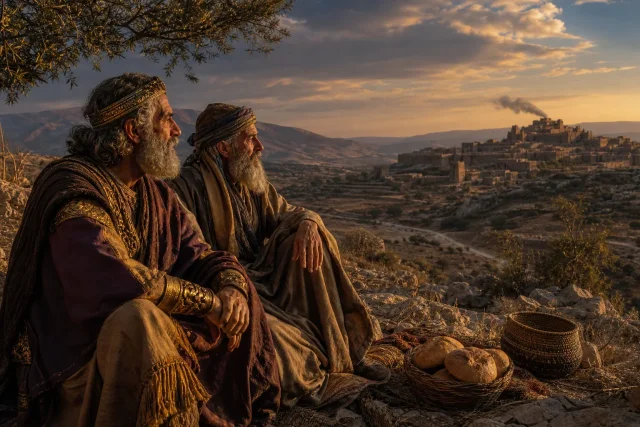
Let me take you back 2000 years. Jesus stands on a hillside in Galilee, not in Caesar’s palace, and He blesses the poor in spirit, the meek, the merciful, the peacemakers. History comes alive when you realize that the kingdom begins by honoring the people empires overlook. In the Sermon on the Mount, light is not a spotlight for self-promotion but a witness that directs attention to the Father. Matthew 5:16 says,
“Let your light so shine before men, that they may see your good works, and glorify your Father which is in heaven.”
The contrast is sharp. The empire tells you to build a brand; Jesus forms a people. The empire tells you to secure your own future; Jesus says seek first the kingdom. The empire tells you to crush enemies; Jesus says love them, pray for them, and refuse revenge. The empire tells you that scarcity rules; Jesus feeds crowds in the wilderness and receives children as if heaven itself has entered the camp.
The archaeological evidence tells us that first-century villages in Galilee were small, rough, and ordinary, with basalt stone, shared courtyards, storage jars, and the smell of fish, smoke, sweat, and bread. That is the setting where the Light of the world walks. Not elite marble halls. Not curated prestige. John 8:12 says,
The Father of lights is made known through the Son, and that means light is no longer merely cosmic; it is personal, embodied, and calling your name.“Then spake Jesus again unto them, saying, I am the light of the world: he that followeth me shall not walk in darkness, but shall have the light of life.”
You see the same reversal in Acts. Believers share possessions. Widows are remembered. Prisons become places of praise. Tables become battlefields where old divisions lose oxygen. In a city obsessed with status, the church calls slaves and merchants, women and men, Jews and Gentiles, brothers and sisters. That is not religious decoration on top of normal life. That is a new creation pressing into old streets.
I think about my own crisis at twenty, when faith felt thin and questions felt loud. I had professors who treated resurrection as naive sentiment, and I had nights when I stared at the ceiling wondering whether I was clinging to inherited stories. Then I stood on an archaeological dig and held pottery fragments weathered by centuries, and the stones cried out that biblical faith is rooted in real places, real dust, real kings, real graves, real witnesses. The Father of lights does not ask you to trust a fantasy. He gives you Jesus in history, Jesus in Scripture, Jesus in the gathered church, and Jesus in the Spirit who turns frightened people into radiant witnesses.
That is the disruption. You stop treating life as a scramble for borrowed brightness. You receive light as communion with the Father through the Son. In traffic, you are not ruled by hurry. In financial stress, you are not abandoned. In conflict, you are not trapped inside your own anger. In sickness, shadows remain real, but they do not become ultimate, because the Father has spoken His light into the dark and His name is Jesus.
Everything changes when:
The Beautiful Scandal
The scandal begins right here: the Father of lights reveals Himself most fully through a crucified Messiah. That sounds backwards because it is backwards by every imperial metric. Picture Golgotha under a bruised afternoon sky, dust sticking to sweaty skin, Roman soldiers shifting their weight in leather sandals, women trembling, and a man hanging in public humiliation. If you were inventing a religion to impress power brokers, you would not place your king there.
Yet that is exactly where the kingdom burns brightest. 1 Corinthians 1:25 says,
The empire trusts spectacle, force, and intimidation. The Father of lights answers with self-giving love, with wounds that heal enemies, with resurrection after apparent defeat. Losing becomes winning, giving becomes gaining, and death itself becomes the doorway through which uncreated light floods the grave.“Because the foolishness of God is wiser than men; and the weakness of God is stronger than men.”
This offends every instinct trained by scarcity. You want a God who helps you dominate anxiety by increasing control. Jesus meets you with surrender. You want a God who defeats opponents by crushing them. Jesus defeats evil by bearing it, exposing it, and rising beyond it. You want a God who keeps your image polished. Jesus strips away image management and calls you into confession, humility, and childlike trust before the Father.
The scandal keeps moving into ordinary life. When financial stress tightens your chest and the spreadsheet on your laptop glows after midnight, kingdom logic says generosity still matters. When relationship conflict leaves dishes untouched in the sink and silence heavy in the apartment, kingdom logic says confession is stronger than pride. When health concerns turn a waiting room into a battlefield of fluorescent lights, antiseptic smell, and clasped hands, kingdom logic says your body is not a machine abandoned to chaos but a life held before the Father who does not change.
I have seen teenagers I mentor reject this because it feels too vulnerable. They would rather post the savage comeback, ghost the friend first, keep the armor on, and act unbothered. Honestly, adults do the same thing with better vocabulary and nicer shoes. The cross offends you because it reveals how addicted you are to self-protection. The Father of lights invites you into radiance by first bringing your darkness into the open.
And still, that offense is beautiful. In the museum world, when you stand before a cracked oil lamp from the first century, tiny enough to fit in your palm, you realize ancient households depended on fragile flames night after night. One breath could threaten them. Then you hear James say there is no shadow of turning with the Father of lights, and suddenly the gospel feels seismic. You do not keep yourself illuminated. You are kept. You are loved. You are brought near through Jesus, not because your flame never flickers, but because His light cannot fail.
The revolution looks like:
Subversive Saints
Picture a fourth-century bishop in a plague-struck city, streets half-empty, doors barred, and the smell of sickness hanging in summer heat. While others flee, Christians stay to nurse the abandoned because they believe the Father of lights is not contaminated by human weakness. History comes alive when we realize that kingdom people have always carried candles into places empires write off. Their witness is not flashy. It is costly, stubborn, and bright.
I think of William Wilberforce laboring against the slave trade for decades, not because progress looked inevitable, but because the light of the Father exposed the darkness of treating image-bearers as cargo. I think of Corrie ten Boom hiding Jews while tyranny marched in polished boots. I think of believers in Acts who sell land to feed brothers and sisters, then gather at tables where social rank loses its grip. The stones cry out through these lives: holy light creates holy resistance.
Then bring it close to your street. I know a bus driver in East Los Angeles who keeps bottled water and granola bars behind his seat because students board hungry. I know a nurse who prays in the parking garage before another twelve-hour shift in oncology, then walks into rooms where fear sits heavy as an extra person in the chair. I know a single mom who still shares soup with her elderly neighbor when her own budget is stretched thin enough to make anyone clench up.
These are subversive saints. They are not famous. They are not trending. They are the kind of people who pause in the Trader Joe’s aisle when an exhausted cashier looks ready to cry, who let another driver merge in the rain without turning the moment into a personal insult, who knock on the apartment door after hearing shouting next door and ask, with real courage, whether anyone needs help. The Father of lights forms people whose reflex is not self-preservation at any cost but embodied mercy.
My mind goes back to college, when I nearly lost faith and a campus janitor named Mr. Alvarez kept speaking hope over me while emptying trash cans at midnight. No platform, no title, just patient words and a worn Bible with loose pages. He treated me as if my doubts were not a threat but a place where God might meet me. That was kingdom light in a fluorescent hallway. That was the Father refusing to leave a confused young man in the dark.
Everything changes when:
Joining the Revolution
Revolutionary call begins with receiving, not performing. If God is the Father of lights, then your first act is not manufacturing brightness but turning your face toward Jesus. Start your day before the phone takes attendance. Sit at the edge of the bed, feel the floor under your feet, and pray James 1:17 back to God. Name the gifts you did not create: breath, forgiveness, sunlight on the blinds, the friend who texted yesterday, the strength to keep going one more day.
Then practice subversion in ordinary spaces. At the grocery store, refuse panic-driven hoarding and pay attention to the person in front of you whose EBT card keeps glitching while people sigh behind them. In traffic, when anger surges and your jaw tightens, treat the other driver as a neighbor with a story, not an obstacle ruining your schedule. In neighborhood interactions, step past polite distance: bring soup, ask names, remember birthdays, offer rides, share tools, and turn porches into places of peace.
Resist empire habits with concrete rhythms. Set limits on screens that train your heart to chase artificial light. Give money away before fear talks you out of it. Confess quickly in relationship conflicts, even when your pulse argues for self-defense. If health concerns have made your life feel clinical and fragile, invite trusted believers to pray in your living room, not only after test results but before them, while the uncertainty still feels sharp.
Build communities where the Father’s light is visible. Eat with people who cannot advance your career. Read the Gospels aloud in your apartment with friends and leave space for silence after the words land. Serve in places where suffering is not hidden behind polished walls: shelters, juvenile halls, hospital waiting rooms, public schools that carry more needs than funding. When you do, keep your eyes on Jesus, because activism without communion burns hot and dies fast.
This is your manifesto: receive every good gift with gratitude, expose every false light with courage, carry mercy into shadowed places, and keep close to the Son who reveals the Father. Join the resistance against hurry, fear, vanity, and isolation. Join the people who believe that no darkness on your block, in your body, or in your family gets the last word. And receive this subversive blessing: may the Father of lights steady your trembling heart, may Jesus make your life a faithful witness, and may your ordinary days shine with a kind of brightness no empire can manufacture or extinguish.
Reflection Questions
Prophetic: How will you subvert the false lights confronting your heart regarding Father of Lights this week?
Action: How might your relationships embody this truth about Father of Lights in one concrete act during grocery shopping, a traffic jam, or a neighborhood interaction?
Relational: How could your small group, family, or church table practice the light of the Father together for someone facing financial stress, relationship conflict, or health concerns?
Continue Your Bible Study
Explore more lessons and deepen your understanding of scripture
View All Lessons Ask AI a Question