When the Body Breaks and Faith Learns to Walk

When Bodies Break God Keeps Covenant
When Everything Falls Apart
The fluorescent lights in the urgent care waiting room hum above me while my phone keeps buzzing with school group texts, a reminder from the pharmacy app, and one message from my husband that says only, How bad is it. My left hand is wrapped in a towel already stiff with blood because I sliced it open on a shattered casserole dish while rushing dinner between algebra help and a toddler meltdown. Across from me, a contractor in dusty boots holds his ribs and winces every time he breathes. A teenage girl in soccer socks presses an ice pack to her ankle and stares at the floor as if betrayal has come through her own body.
Physical trauma arrives that way in ordinary places. A car skids in rain on the interstate near the grocery store exit. A biopsy report lands in the patient portal at 10:43 p.m. A mother throws out her back lifting a laundry basket and suddenly cannot bend to buckle the baby into the car seat. In the midst of chaos, God whispers, but first the chaos is real. The body throbs, swells, bleeds, trembles, and all the brave spiritual language in the world can feel very far away from an MRI machine and a stack of medical bills.
I remember the year after I left corporate life, when I thought my deepest wound was identity. Then my son broke his arm falling from the monkey bars during a parish picnic the week before Pentecost. His cries were animal and holy all at once, and my own body shook so hard I could barely sign the intake form. The kitchen table became an altar later that night, cluttered with discharge papers, children’s Motrin, a half-finished rosary, and a blue sling that smelled faintly of playground mulch. I had no polished theology then, only a mother’s ache and the stubborn need to believe Christ was present in the fracture.
Physical trauma can also be hidden after the cast comes off. Scar tissue pulls. Nerves misfire. Sleep breaks apart because the body remembers what the mind wants to file away. A veteran ducks at fireworks on the Fourth of July. A woman freezes when tires screech in a parking lot. A warehouse worker goes back to his shift after a fall, smiling through pain because rent is due Friday. Between diaper changes and dishes, between traffic jams and neighborhood small talk, bodies carry stories we do not always see. And when flesh becomes the site of fear, many of us quietly ask whether God draws near to bruised muscle, surgical stitches, and bones that never set quite right.
Ancient Cries Timeless Pain
Scripture is far less sanitized than we sometimes make it at Bible study tables with coffee cake and colored pens. Bodies in the biblical story are struck, limping, bleeding, exhausted, burned by fever, crushed by grief, and marked by violence. One of the most haunting scenes for me is tucked into 2 Samuel 4, where we are told almost in passing about Mephibosheth: “Jonathan, Saul's son, had a son who was crippled in his feet. He was five years old when the news about Saul and Jonathan came from Jezreel; and his nurse took him up and fled; and as she fled in her haste, he fell and became lame. And his name was Mephibosheth.” A child falls in the chaos of national tragedy, and his body bears that moment for life.
That verse feels painfully modern. Trauma often comes through someone else’s panic, someone else’s speed, someone else’s sin, someone else’s war. A child in a back seat during a collision did not choose the wreck. A spouse recovering from assault did not choose the wound. A laborer injured because a company cut safety corners did not choose the fall. My vocation as mother teaches me that vulnerability is not weakness; it is the condition of being human. Mephibosheth enters the story not as an object lesson but as a man whose body tells the truth about a broken world.
Then there is Jacob, and I do not mean the polished Sunday school version. In Genesis 32 he wrestles through the night and leaves marked in his hip. “When the man saw that he did not prevail against Jacob, he touched the hollow of his thigh; and Jacob's thigh was put out of joint as he wrestled with him.” This is not triumphant spirituality floating above flesh. It is encounter that leaves a limp. Israel is born with altered gait, and that matters. Some meetings with God do not remove bodily weakness; they consecrate it.
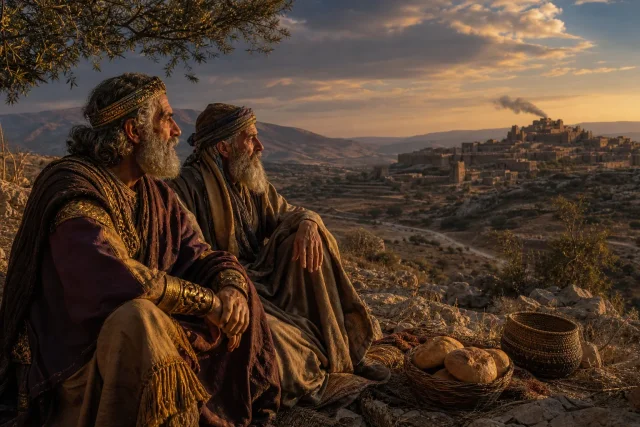
I also think of Elijah under the broom tree in 1 Kings 19. His crisis is emotional and spiritual, yes, but it lands in the body: collapse, sleep, hunger, depletion. The angel does not begin with a lecture. The angel brings baked bread and water. Finding Christ in the mundane means taking seriously that divine tenderness often reaches us through calories, rest, touch, and time. Catholics know this in our bones because grace comes through matter. Bread, oil, water, hands, ashes. Dios mio, what mercy that heaven does not despise the body.
And then there is the Shunammite woman in 2 Kings 4, running with the weight of her son’s sudden bodily crisis pressing against her heart. She lays him on Elisha’s bed before the Lord’s servant comes. The scene is domestic and desperate. A mother, a room, a child, a bed. I have stood in bedrooms after fevers spike and felt how biblical that room can become. Ancient cries are not antique. They sound like tires in an ER parking lot, the beep of a pulse oximeter, and a whispered Hail Mary in the dark.
Because of this, physical trauma in Scripture is not a side note. It is woven into covenant history. The lame child, the limping patriarch, the exhausted prophet, the grieving mother all stand close enough for us to touch their sorrow. They remind us that God’s people have always brought injured bodies into the holy story, not as interruptions to faith but as places where faith must kneel and keep watch.
The Unbreakable Promise
The covenant response to physical trauma is not denial. It is presence, remembrance, and the astonishing refusal of God to waste wounded flesh. The first promise I cling to rises from the psalms of embodied fragility. Psalm 147:3 says, “He heals the brokenhearted, and binds up their wounds.” I know that verse is often quoted for emotional pain, but the image is earthy and tactile. Binding wounds is the work of hands. It sounds to me like gauze unrolled on a kitchen counter, antibiotic ointment, a father changing a bandage before Mass, a nurse securing tape with practiced tenderness. The God of Israel is not embarrassed by medical care. He is named in the language of it.
There is also a deeply covenantal tenderness in Exodus that reaches farther than many of us expect. When the Lord reveals Himself as healer in Exodus 15:26, He speaks to a people freshly delivered yet still vulnerable in body and soul. He is not a distant concept but the One who enters camp life, water needs, contagion fears, and wilderness fatigue. The promise is not that Israel will never ache. The promise is that their life as a people will be held inside His faithful care. In Catholic life, I hear an echo here in the Anointing of the Sick, where oil becomes an offering of mercy to the suffering body.
The prophets deepen this promise in a surprising way. Zechariah gives us a vision of the coming king that does not erase wounds but bears them into revelation. Zechariah 13:6 asks, “And if one asks him, ‘What are these wounds on your back?’ he will say, ‘The wounds I received in the house of my friends.’” Christians have long heard in that line an ache that reaches toward Christ. Wounds are not hidden from the covenant story. They become testimony. This is a hard grace-filled truth for those of us carrying scars from surgeries, accidents, abuse, or illness. The scar is not the whole story, but neither is it banished from the redeemed story.
Then the New Testament brings the promise into the flesh of Jesus with sacramental force. After the Resurrection, our Lord does not return polished and untouched. He keeps His wounds. John 20:27 gives us these words: “Then he said to Thomas, ‘Put your finger here, and see my hands; and put out your hand, and place it in my side; do not be faithless, but believing.’” The risen Christ is glorified and still marked. This changes everything: healing in the Christian imagination is not always a rewind to an unwounded past. Sometimes it is communion with the wounded and risen Lord who carries transfigured scars.
That matters for the woman with the C-section scar she resents, the man whose knee will never fully recover after the construction accident, the teenager whose face bears burns from a house fire, the grandmother whose chemotherapy port left a line across her chest. Christ’s covenant promise is larger than bodily restoration on our preferred timeline. He pledges Himself. He gives His Body in the Eucharist to our bodies. He lets the Church become a field hospital and a family table. The kitchen table became an altar for me more than once, but every altar at Mass also becomes a place where wounded people are fed by wounded Love.
I think too of Saint Bernadette, sickly and often in pain, and Saint John Paul II, bent and trembling in public suffering, and Saint Gianna, whose maternal body became an offering. The saints do not romanticize agony. They place it in union with Christ so that trauma does not become the final name over a life. Here is the covenant at its most radiant: your injured body is not outside redemption, not beneath reverence, not forgotten in the economy of grace. The Lord who took flesh has bound Himself to flesh forever. He will not abandon what He has joined to Himself.
The Sacred Transformation
When physical trauma enters a home, transformation rarely feels dramatic. It looks more like a family calendar rewritten in blue ink around physical therapy appointments, follow-up scans, meal trains, and school pickup help from a neighbor named Elena who texts, I’m outside. It looks like surrender in small doses. My vocation as mother teaches me that holiness often arrives wearing compression socks and carrying a water bottle. The sacred enters rehab rooms, orthopedic clinics, and the slow work of taking the next step without pretending the pain is gone.
One practical step is to let the body pray honestly. Not perform. Pray. If you cannot kneel, sit. If you cannot sit still, walk the hallway with the rosary wrapped around your wrist. If words fail, place a crucifix near the bed and breathe the Holy Name. I have prayed while heating tortillas, while waiting in traffic outside the imaging center, while folding tiny socks with one hand because the other was stitched. Between diaper changes and dishes, God receives fragmented prayer as a holy offering.
Another step is sacramental realism. Go to Mass if you can. Ask for the Anointing of the Sick when serious illness or surgery enters the picture. Let others bring meals, drive children, cover a shift, sit in silence. Pride hates dependence, but covenant life is communal. Saint Paul does not describe the Church as a collection of self-sufficient achievers. He speaks of a body. When one member hurts, the others do not send inspirational quotes and disappear. They stay.
I also urge practical tenderness with triggers and limits. Trauma can make grocery shopping feel dangerous when a loud crash in aisle seven sends the heart racing. It can turn traffic jams into panic because being trapped recalls the accident. Name that without shame. Keep a small prayer card in the car. Tell one trusted friend what happens in your body. Ask your parish for concrete support, not vague intentions only. In the midst of chaos, God whispers through casseroles, carpools, and therapists who honor human dignity.
Here’s where it gets revolutionary: transformation does not require us to call evil good. A broken bone is still broken. Violence is still evil. Medical negligence is still sin. Yet grace-filled surrender means placing even this in Christ’s pierced hands and refusing isolation. Little by little, the wounded body ceases to be only a site of fear and becomes, mysteriously, a place where communion deepens. Not because pain is holy in itself, but because Christ enters it and remains.
Living as Covenant People
To live as covenant people after physical trauma is to treat the body with reverence instead of contempt. That may mean going to physical therapy faithfully, taking medication without guilt, resting on a Sunday afternoon, or saying no to the pressure to bounce back for appearances. In my old corporate life, I admired efficiency almost as a creed. Family life and suffering stripped that from me. Now I see that slowness can be obedient. Recovery can be a vocation.
I think of a dad in our parish who lost partial mobility after a motorcycle accident. He now arrives early to Mass because stairs take time, and his teenage son walks beside him without hurry. Their pace has changed the whole family. They pray Night Prayer together. They keep Fridays as a quieter evening with soup, candles, and gratitude spoken aloud. The wound did not vanish, but the household became more attentive, more tender, more holy in ordinary ways.
I think of a mother from my neighborhood who still grips the shopping cart too tightly after a car crash. She keeps Saint Christopher on her dashboard, attends trauma therapy, and asks another mom to drive on stormy days. That is not failure. That is wisdom. Finding Christ in the mundane means seeing covenant faith in seat belts buckled with trembling hands, in prescriptions picked up before dinner, in neighbors who rake leaves after surgery without making a speech about it.
So I make this declaration with all the honesty I can gather: Lord Jesus, my body and the bodies I love are Yours. What is bruised, scarred, shaking, aching, limited, or afraid is not abandoned ground. Bind what is torn. Guard what is vulnerable. Consecrate our homes, our hospital rooms, our rehab exercises, our sleepless nights. Make every table an altar of mercy and every wound a place where Your promise outlasts our fear. Santa Maria, Madre de Dios, stay near us. Christ has kept His scars, and because He has, I can believe even broken flesh may yet sing.
Reflection Questions
Introspective: What within you still treats your wounded body as a problem to hide instead of a person to receive with compassion before God?
Action: What concrete act of care will you take this week for a physically traumatized body, your own or someone else’s: a doctor’s appointment, a meal, a ride, a confession, a request for anointing?
Prophetic: What patterns in your home, workplace, parish, or neighborhood need confronting so that injured and disabled bodies are honored rather than rushed, ignored, or shamed?
Continue Your Bible Study
Explore more lessons and deepen your understanding of scripture
View All Lessons Ask AI a Question