Questions and Answers in Luke

Questions About Luke
The Empty Chair
You know that feeling when the apartment is too quiet and the microwave beeps louder than it should. A paper bowl of ramen sits on the desk beside a glowing MacBook, Slack still open, Zoom camera off, notifications stacking up from Instagram and Discord, and nobody is actually with you. The chair across the table stays empty. Your stomach is full enough, but something deeper keeps scraping the inside of your chest. Hunger is not always about calories. Sometimes it is about being unseen.
Luke writes into that ache with unusual precision. He was a careful researcher, the kind of person who would probably keep color coded Notion docs and timestamped interview notes if he lived in San Jose today. In Luke 1:3-4 he says, “it seemed good to me also, having followed all things closely for some time past, to write an orderly account for you, most excellent Theophilus, that you may have certainty concerning the things you have been taught.” That line matters. Luke is not tossing random spiritual vibes into the cloud. He is building a reliable interface between eyewitness memory and your questions.
Questions about Luke usually start where loneliness and logic collide. Who was he. Why does he care so much about meals, outsiders, women, the poor, and people standing at the edge of the room. Why does his Gospel keep zooming in on faces at tables, tears on feet, bread in hands, and people who were not invited by polite religion. Think of it like this app: Luke is debugging the assumption that God only sits with the polished users. He keeps pulling the camera toward the excluded one in the corner.
If you have ever eaten takeout alone in a parked car after a brutal shift, or scrolled past photos of everyone else laughing under warm restaurant lights while you reheated leftovers, Luke feels personal. He knows spiritual hunger has texture. It sounds like silverware in the next room and your own silence in this one. It feels like standing outside the door, wondering whether there is a seat with your name on it. That is why Questions About Luke matter. He writes for people who need certainty, yes, but also for people staring at an empty chair.
Pull up a chair:
The Scandalous Dinner Guest
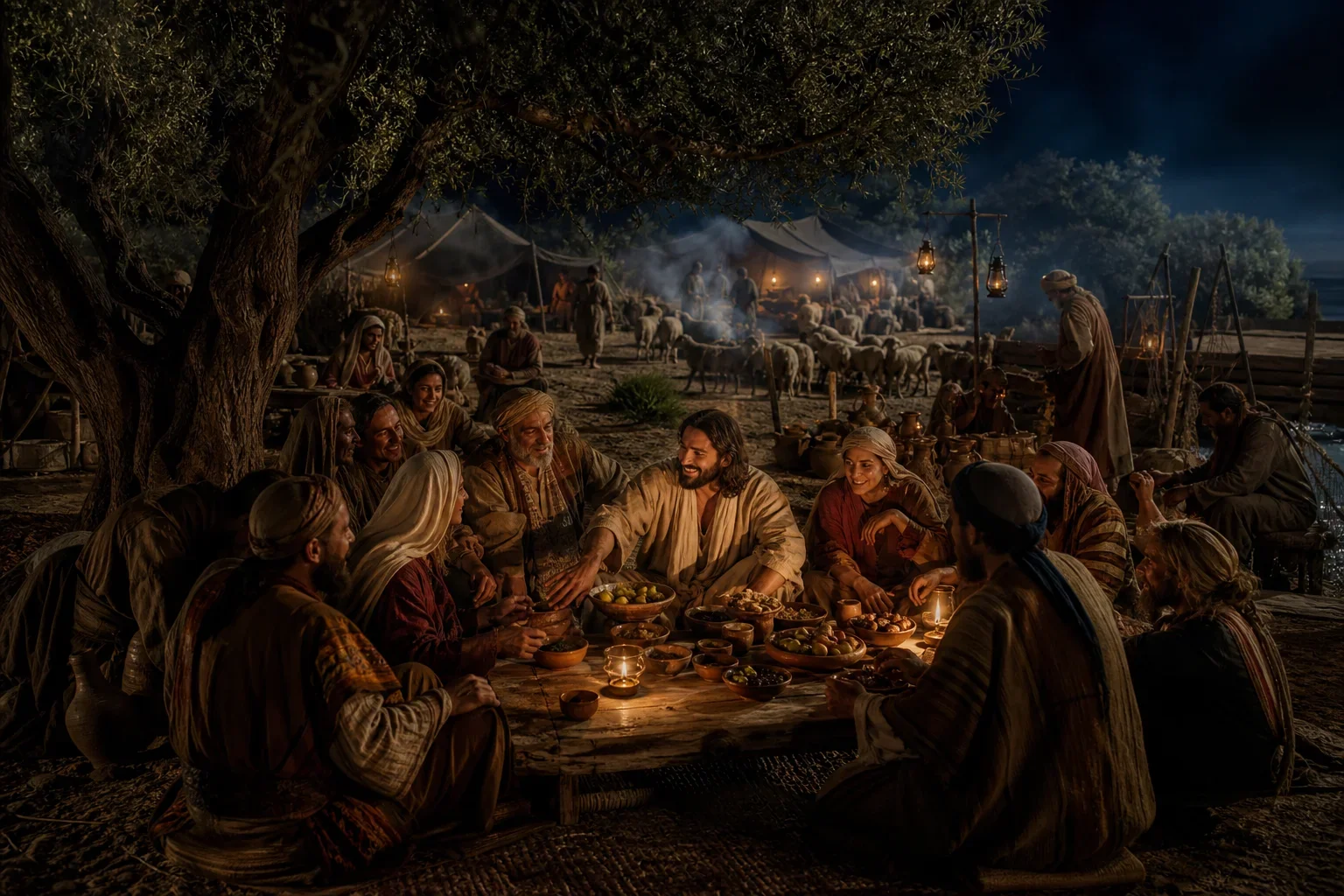
Luke answers your questions by putting Jesus at tables that make respectable people nervous. Not safe tables. Not curated brand tables. Scandal tables. If you read Luke closely, meals are not background scenery. They are mission sites. They are where status gets hacked, where shame gets exposed, and where grace walks in wearing dust on its feet. Jesus keeps accepting invitations from Pharisees, tax collectors, doubters, and crowds with empty stomachs. He is never anxious about guilt by association because he is the holy one changing the room from the inside.
Take Luke 5. Levi throws a huge banquet after meeting Jesus, and the guest list is the kind that would light up religious group chats for all the wrong reasons. Luke 5:29-32 says, “And Levi made him a great feast in his house, and there was a large company of tax collectors and others reclining at table with them. And the Pharisees and their scribes grumbled at his disciples, saying, ‘Why do you eat and drink with tax collectors and sinners?’ And Jesus answered them, ‘Those who are well have no need of a physician, but those who are sick. I have not come to call the righteous but sinners to repentance.’” Jesus does not deny the scandal. He reframes it. The table is triage.
That matters historically too. Luke writes with an eye for social reversal. In the first century, table fellowship signaled identity, loyalty, purity, and rank. Who you reclined with was not random. It was social source code. So when Jesus dines with people tagged as compromised, he is not making a vague statement about niceness. He is announcing the kingdom in visible form. If then the kingdom arrives, then the seating chart gets rewritten. That is God’s algorithm for life in Luke.
Then there is the feeding of the multitude, where hunger goes public. Luke 9:16-17 says, “And taking the five loaves and the two fish, he looked up to heaven and said a blessing over them. Then he broke the loaves and gave them to the disciples to set before the crowd. And they all ate and were satisfied. And what was left over was picked up, twelve baskets of broken pieces.” This is not just a miracle flex, though it is definitely that 🔥. It is kingdom abundance in a place of scarcity. No one gets a demo portion. Everyone is satisfied.
Luke also frames the Last Supper with deep covenant weight. Luke 22:19-20 says, “And he took bread, and when he had given thanks, he broke it and gave it to them, saying, ‘This is my body, which is given for you. Do this in remembrance of me.’ And likewise the cup after they had eaten, saying, ‘This cup that is poured out for you is the new covenant in my blood.’” Questions about Luke hit a crucial point here. His Gospel links ordinary table actions with cosmic redemption. Bread and cup become the interface where memory, sacrifice, promise, and presence meet. That is not sentiment. That is the divine source code running in plain sight.
Luke even keeps the table open after resurrection. Emmaus is classic. Two disappointed disciples walk with Jesus and fail to recognize him until the bread is broken. That scene is peak Luke. Eyes open at a table. Hearts burn on the road. You could say their faith OS gets upgraded in real time. The risen Christ is known in word and meal, in Scripture and table, in truth and tangible action. Luke keeps answering your questions with one massive claim: Jesus is the scandalous guest who becomes the host, and nobody in need is beneath his invitation.
Pass the bread:
Theology of the Table
If Luke keeps bringing you back to tables, it is because the table is never just furniture. It is theology with plates on it. It is covenant made visible. It is memory you can taste. In Luke, eating is earthy and spiritual at the same time, not split apart into separate folders. Let’s debug this spiritual issue: if you reduce meals to symbols only, you miss Luke’s realism. If you reduce them to social events only, you miss Luke’s glory. He writes with both feet on the ground and both eyes on the kingdom.
Luke’s language and structure push this hard. He highlights blessing, breaking, giving, and receiving in repeated meal scenes. That pattern matters. It creates a rhythm that points beyond itself. Questions about Luke often ask whether he has a sacramental instinct. Short answer: yes, deeply. He does not flatten communion into bare mental recall. He presents it as covenant participation rooted in Christ’s self-giving act. The bread and cup do not become magic objects, but neither are they empty props. They are God-appointed signs carrying covenant reality to embodied people.
Listen to Luke 22:16 again in context of future hope: “For I tell you I will not eat it until it is fulfilled in the kingdom of God.” Then Luke 22:18 says, “For I tell you that from now on I will not drink of the fruit of the vine until the kingdom of God comes.” Jesus ties the present table to a coming feast. Communion is backward looking and forward looking at once. It remembers the cross and anticipates the banquet. Think of it as a live beta release of the kingdom meal, a faithful preview before the full launch.
Luke also links table theology to reversal. In his Gospel, the low are lifted, the proud get confronted, and guests who assumed VIP status are told to move down. At one dinner Jesus says the host should invite “the poor, the crippled, the lame, the blind” in Luke 14. That is not performative virtue signaling. That is kingdom logic. The meal becomes a public parable of grace. If then grace is real, then no table centered on Jesus can be built on status optimization.
The eschatological angle is massive. Luke loves feast imagery because the kingdom is not a sterile data set. It is abundance, joy, embodied presence, reconciled people, and the host who has scars in his hands. Isaiah’s mountain feast echoes in the background, and Luke routes that hope through Jesus. The final future is not disembodied drift in a vague spiritual cloud. It is renewed creation with the Messiah at the center. Time to upgrade your faith OS: salvation is not escape from the table. Salvation is being brought home to it.
The table is set:
Setting the Table
So what do you do with Questions About Luke on a Tuesday night when your calendar is chaos and your phone battery is at 12 percent. You make the theology tangible. Actual people. Actual place. Actual food. Not polished influencer content with Edison bulbs and perfect sourdough scoring. I mean a scratched dining table in a Fremont apartment, a Costco rotisserie chicken, rice in the cooker, and one extra chair pulled in from the desk. Luke pushes faith out of abstraction and into embodied welcome.
I felt this hard after college when I was climbing in startup culture and quietly losing myself to gaming addiction. I could code all day, raid all night, and still feel hollow by 2 a.m. with blue monitor light on my face. Recovery did not happen through hype alone. Part of God’s rescue process came through ordinary tables. A roommate, then church friends, kept making space where I did not have to perform. No filter. No ranking. Just truth, prayer, food, and the slow rewiring of desire. Think of it like this app: grace often downloads through repeat practices.
Luke 14 pushes you toward intentional invitation, especially toward people who cannot boost your brand. That could mean the new engineer on your team who moved from Seoul and spends lunch alone with AirPods in. It could mean the single mom from church who logs into every Bible study on mute because bedtime chaos is real. It could mean your elderly neighbor who still uses a flip phone and has stories nobody asks for anymore. If then Jesus welcomed beyond status, then your table cannot run on networking logic.
This can scale in simple ways. A family can set one night each week when screens go face down in a basket by the door. A small group can rotate homes and make space for one person outside the normal circle each month. A church can treat the potluck not as random carbs in foil trays but as kingdom rehearsal, where the software designer, delivery driver, widow, teenager, and recent immigrant all belong in the same room. That is not accidental. That is discipleship with plates and chairs.
And yes, there are risks. Awkward pauses. Burned food. Kids spilling juice. Somebody talking way too long about crypto. Welcome to embodied life. Luke does not offer frictionless community because real grace is not a frictionless product. It has texture. It costs time. It interrupts convenience. Yet that is where Christ often meets people. Set the table anyway. Leave margin. Pray over the names in your contacts. Then open the door.
Pull up a chair:
Foretaste of the Feast
Luke refuses to let your table stop at the present moment. Every faithful table points ahead. Every broken loaf whispers that a greater banquet is coming. Every cup lifted in Christ’s name previews a day when grief loses its login credentials and death gets fully deleted. This is where Questions About Luke get bright with hope. He writes with historical care, yes, but he is not building a cold archive. He is handing you a future.
The future arrives in Luke through feast language again and again. Jesus speaks of people coming from east and west and north and south to recline at table in the kingdom of God. He tells parables about great banquets and rejected invitations. He promises new wine in the kingdom. This is wedding feast energy, not minimal survival mode. The kingdom is not God barely tolerating redeemed people. It is the Father receiving them with joy because the Son has secured their place.
That hope hits differently in a fragmented age. You can have 1,800 LinkedIn connections, three active group chats, and still feel radically alone after closing your laptop in a studio apartment while rain taps the window and sirens bounce off downtown glass. Digital life is useful, but it cannot replace embodied presence. Luke knows humans are not brains on sticks. We are made for resurrection life, renewed bodies, and the presence of Christ. The coming feast is not metaphor only. It is promise with substance.
Communion keeps that promise in front of you. When the church takes bread and cup, you are not pretending everything is fixed. You are proclaiming that Jesus was broken for sinners, raised in victory, and returning as host. The meal is both protest and promise. Protest against isolation, injustice, death, and shame. Promise that none of those powers gets the last word. If then Christ is risen, then your emptiest chair is not the end of the story.
So set a table in hope. Light the room. Put out enough plates. Pray for the missing people and the hard people and the tired people. Bring your questions about Luke with you, because he can handle them. His Gospel was written for certainty, for embodied grace, and for hungry hearts waiting for the kingdom. Lord Jesus, make our tables honest, wide, and holy. Train our eyes to recognize you in the breaking of the bread. Keep us faithful until the day you drink the new wine with your people in the kingdom, and every chair is filled by grace.
Reflection Questions
Relational: How can you and others embody Luke’s table-centered vision this month in a way that makes room for the person who usually stays at the edge of the room?
Action: Who will you invite into a real seat at your table this week, and what specific date, time, and place will you put on the calendar today?
Contemplative: Rest in this tension: when you picture Jesus as both scandalous guest and sovereign host, where do you feel resistance, and what hunger underneath that resistance needs to be named before God?
Continue Your Bible Study
Explore more lessons and deepen your understanding of scripture
View All Lessons Ask AI a Question