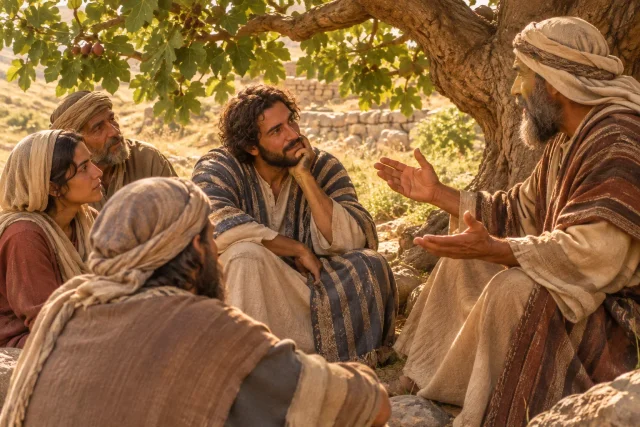
Nourishing Body and Soul Through Bible Nutrition

Bible Nutrition through Death and Resurrection
You can starve with a full pantry. You can own three study Bibles, keep a verse-of-the-day app on your phone, hear a podcast in traffic on I-35, and still carry a soul that is malnourished, shaky, irritable, and thin. That is the death we have to name at the start: not a lack of religious content, but a diet of Bible crumbs, spiritual sugar, and hurried words chewed without hunger for Jesus himself.
Picture yourself standing in a grocery store aisle under cold fluorescent lights, comparing protein labels and ingredient lists, while your inner life survives on whatever verse snippet scrolls past between text messages and bank alerts. You feel the weight of that, especially when financial stress tightens your chest, when a relationship conflict sits unresolved in the front seat beside you, when a doctor’s voicemail leaves your stomach in knots. I have lived close to that kind of thinness, and in college, when my faith nearly collapsed, I found out you can quote truth and still be starving for the living Christ who speaks it.
Naming What Must Die
Bible nutrition starts with a funeral, because something in you has to stop breathing if the Word is going to become bread instead of background noise. The first thing that must die is the identity that treats Scripture as a performance stage, where you collect facts, stack cross references, and try to look spiritually fit in front of other people while your private appetite is dead. Picture a student highlighting half the page in neon yellow, posting a photo of coffee, journal, and open Bible on Instagram, then snapping at his mom ten minutes later because his heart has not eaten what his eyes scanned.
The second thing that must die is the destructive pattern of snacking on Scripture only when life catches fire. You hit traffic after work, your gas light is on, your checking account is low, and only then do you reach for a random verse as emergency calories. Ancient Israel did this in cycles, running to the Lord in famine and wandering off in abundance, and history comes alive when you realize the same pattern plays out in a modern apartment kitchen with unopened mail on the counter and a microwave humming in the background.
False security has to die too, especially the version that trusts Bible information more than the Christ to whom the Bible bears witness. Jesus says in John 5:39-40,
That is a stunning scene; religious experts stand surrounded by sacred text and still miss the living Messiah in front of them. The archaeological evidence tells us first-century Jews were serious about texts, traditions, and public piety, yet the stones cry out that proximity to Scripture is not the same as feeding on Jesus.“You search the Scriptures because you think that in them you have eternal life; and it is they that bear witness about me, yet you refuse to come to me that you may have life.”
Another death is the old habit of consuming the Bible the way social media trains you to consume everything else, fast, fragmented, and emotionally shallow. You scroll headlines, clips, reels, and outrage, and then you bring that same twitchy attention span to the Psalms, the Prophets, or the Gospels. Bible nutrition cannot survive on spiritual fast food, because manna was gathered daily, not binged once a month, and bread in the ancient world was worked by hand, kneaded, waited on, and baked with patience.
One more thing must die: the lie that your soul can be nourished while your life stays untouched. If Scripture is only inspiration for your notes app, and never reaches your spending, your dating, your speech in neighborhood disagreements, or your response to health fears, then you are tasting without swallowing. The old self wants the comfort of holy words without the surrender those words demand, and that old self must be carried to the grave.
Then comes the dying:
The Descent into Death
Dying to a junk-food approach to the Bible is not clean or cinematic in the polished streaming-series sense; it is more Gethsemane than graduation. Jesus says in Luke 22:42,
Picture the olive trees under a dark sky, damp air clinging to skin, disciples fighting sleep, and the Son of God facing surrender with full awareness of the cost. Bible nutrition begins there, where your will stops demanding a devotional experience tailored to your mood and starts bowing before the living voice of Christ.“Father, if you are willing, remove this cup from me. Nevertheless, not my will, but yours, be done.”
The descent often looks ordinary on the outside. You wake at 6:12 a.m., the apartment still gray with early light, and instead of grabbing your phone to check overnight messages, sports scores, and work email, you leave it face down on the dresser and sit with an open Gospel. Everything in you resists that silence; your mind darts to bills, to the weird text from your brother, to the lab results due Friday, to the argument you had in the car after church. That resistance is not proof something is wrong; it is often the sound of an appetite being retrained.
I remember a season in college when my faith was hanging by a thread, and I kept trying to solve the crisis with arguments alone. I had read enough to sound sharp, but not enough with my knees on the floor and my heart cracked open before Jesus. On an archaeological dig years later, brushing dirt from ancient pottery in dry heat, I kept thinking about layers, how the surface can fool you, how deeper truth takes patience, sweat, and humility; Scripture works that way too, pressing past your curated image into the buried loyalties underneath.
There is pain in letting the Bible expose you instead of merely encouraging you. Hebrews 4:12 says,
That piercing is the moment when a passage about anxiety stops being a nice underlined promise and becomes a mirror for your control, when a command about forgiveness lands in the middle of a family feud, when generosity confronts the way financial fear has become your secret master.“For the word of God is living and active, sharper than any two-edged sword, piercing to the division of soul and of spirit, of joints and of marrow, and discerning the thoughts and intentions of the heart.”
This descent also strips away ego. You stop reading merely to win debates, to impress a small group, or to collect theological trophies, and you start reading as one who is poor, hungry, and needy. Picture Peter by the charcoal fire after failure, shoulders heavy, eyes lowered, hearing the risen Jesus address him not as a résumé but as a wounded man still called to love; Bible nutrition takes root in that kind of humility, where you admit you are not feeding yourself well and cannot heal your own appetite.
The dying keeps cutting because the Word reaches into traffic jams, grocery lines, and neighborhood tensions. It asks what rules your reactions when someone cuts you off, when egg prices climb again, when your partner goes quiet at dinner, when your body aches and WebMD whispers worst-case scenarios at midnight. To feed on Scripture in a gospel way means the old self loses its right to stay untouched, and that loss can feel painfully slow.
In the darkness:
Holy Saturday Waiting
After the dying comes a strange silence, the Holy Saturday space where the old appetite is being buried and the new one has not yet felt strong. Picture Jerusalem the day after crucifixion, streets still dusty, doors shut, grief hanging in the air thick as smoke after a fire, disciples replaying shattered expectations in whispers. That in-between place matters for Bible nutrition because many people quit here; they expected instant delight, instant clarity, instant emotional lift, and instead they meet quiet, weakness, and the ache of absence.
This waiting can feel unnerving in a modern life built on speed. You read a Psalm before work and feel no fireworks. You sit in your car outside H-E-B with rain ticking on the windshield, reread a paragraph from John, and still carry the same financial pressure, the same conflict with your sister, the same uncertainty after a doctor mentions more tests. In that moment, you may assume nothing is happening, but ancient agriculture says otherwise: seeds split underground long before green shoots break the surface.
Psalm 1 paints this patient picture with earthy realism:
Notice the phrase in its season. Fruit does not appear on command, and roots are hidden work. History comes alive when we realize that in the ancient Near East, water access meant survival itself; a tree by steady streams endured when shallow-rooted growth browned under heat.“He is like a tree planted by streams of water that yields its fruit in its season, and its leaf does not wither. In all that he does, he prospers.”
Holy Saturday Bible nutrition is staying near the stream when your taste buds still crave old sugar. It is reading a Gospel slowly while your emotions stay flat, praying a Psalm when your mind wanders, returning to Jesus’ words after another rough neighborhood conversation or another tense evening balancing the budget. I have watched teenagers I mentor go through this with fitness, too; when a body has lived on chips and soda, real food can taste strange at first, yet over time the appetite changes.
There is also a wilderness quality here. Israel gathers manna one day at a time, no stockpiling, no illusion of self-sufficiency, just daily dependence under open sky. Bible nutrition in the waiting trains you to come again tomorrow, not because every reading feels dramatic, but because Christ is forming hunger and trust in hidden ways. The tomb stays closed for a time, and faithful waiting beside that sealed stone is part of the pattern, not a failure of it.
But Sunday is coming:
The Unexpected Morning
Resurrection in Bible nutrition rarely arrives as a flashy religious high. More often it comes the way Easter morning comes in the Gospels, through surprise, confusion, and gradual recognition. Picture the first light over the garden, cool air, damp earth, women carrying spices, grief still heavy in their bodies, and then the shock of absence where death was supposed to remain in control. John 20:16 records the turning point in one word:
The risen Christ makes himself known personally, and that is the heart of Bible nutrition: not merely reading words about Jesus, but being met by the living Jesus through those words.“Jesus said to her, ‘Mary.’”
The new life often begins in small moments that would look unimpressive on camera. A passage you have read ten times suddenly presses into your real Tuesday. You are stuck in traffic, brake lights glowing red in the rain, and instead of spiraling into anger, a line from the Sermon on the Mount steadies your breathing. You are standing in the cereal aisle doing mental math because rent is due, and a promise from Matthew about the Father’s care interrupts panic long enough for prayer to rise where fear usually dominates.
That is resurrection breaking in, not as denial of real problems, but as the presence of Christ in the middle of them. The Emmaus story captures this beautifully. Luke 24:32 says,
Their eyes are slow, their grief is real, and recognition unfolds step by step; the Bible becomes nourishment when Jesus opens it and your heart begins to warm again after a long cold season.“They said to each other, ‘Did not our hearts burn within us while he talked to us on the road, while he opened to us the Scriptures?’”
I have seen this in students, in single moms, in exhausted dads working double shifts, in a friend sitting beside a hospital bed with a paper cup of stale coffee and an open Psalm on his lap. Nothing around them changes instantly. Bills remain, chemo schedules remain, strained marriages still need repair. Yet the Word becomes more than data; it becomes bread, oxygen, witness, and companionship because the risen Christ meets them there.
The biblical story arc deepens this angle. In Eden, food and trust are bound together; in the wilderness, manna trains dependence; in the Gospels, Jesus feeds crowds and calls himself bread; at the cross, he enters death; at resurrection, he eats with his disciples, proving embodied life restored. Picture the continuity: from garden to desert to upper room to empty tomb, God is forming a people who do not merely consume calories, but receive life from his hand. Bible nutrition becomes gospel-shaped when you stop asking only, “What principle can I extract?” and start asking, “How is the risen Jesus feeding me with himself through this text today?”
This morning light can arrive gradually. You notice you are less reactive in neighborhood conflict, quicker to repent after sharp words, slower to doomscroll at midnight, more able to sit with a suffering friend without reaching for clichés. The stones cry out that resurrection is not fantasy; it leaves footprints in habits, relationships, and desires.
Learning to Live Again
Resurrection life needs retraining, because a raised person still has to walk. Bible nutrition in this stage becomes practical, embodied, and repeatable. You set a real time and place, maybe the kitchen table at 6:30 with one lamp on and your phone in another room, maybe a park bench during lunch break with buses hissing past and city noise in the background. The point is not aesthetic perfection; the point is making room for daily bread from Christ rather than waiting for spiritual cravings to appear on their own.
New practices matter here. You read whole scenes from the Gospels instead of isolated slogans, because narrative feeds your imagination with the actual Jesus. You pray the text back to God, you write one concrete act of obedience, and you carry one verse into the day the way ancient travelers carried provisions. When conflict rises at home, when a co-worker sends that passive-aggressive email, when health fears return at 2:00 a.m., the Word is no longer decoration on the shelf but nourishment already in your system.
Transformed relationships become one of the clearest signs of this new life. Colossians 3:16 says,
Notice that the Word dwelling richly spills into community. A nourished soul speaks differently in the neighborhood, listens differently at the dinner table, and carries a different presence into hard conversations about money, trust, parenting, and pain.“Let the word of Christ dwell in you richly, teaching and admonishing one another in all wisdom, singing psalms and hymns and spiritual songs, with thankfulness in your hearts to God.”
Still, living again includes stumbles. Even after resurrection appearances, the disciples are startled, hesitant, and slow to piece everything together. You will have days when the old junk-food habits return, when you skim instead of feast, when anxiety drowns out attention, when you reach for noise rather than silence. Do not romanticize the process; raised life still requires dependence, and the risen Christ is patient with people whose legs are still getting steady.
So here is the invitation. Let the shallow, hurried, performative way of approaching Scripture die. Bring your appetite, your doubt, your financial stress, your relationship mess, your health concern, your distracted mind, and place them before Jesus, who meets hungry people with life. Risen Lord, kill what starves us, bury what keeps us feeding on substitutes, and raise in us a deep hunger for your voice, so that in your Word we may meet you, receive you, and live again.
Reflection Questions
Where in your life reflects the truth about Bible Nutrition, and where are you still trying to survive on spiritual snacks instead of feeding on Jesus himself?
Return throughout your day to this phrase: Bible Nutrition; as you sit in traffic, shop for groceries, or lie awake with concern, where do you sense Christ inviting your hunger to become dependence?
What specific act will you take in the next twenty-four hours to make space for Scripture as daily bread rather than emergency rations?
Continue Your Bible Study
Explore more lessons and deepen your understanding of scripture
View All Lessons Ask AI a Question