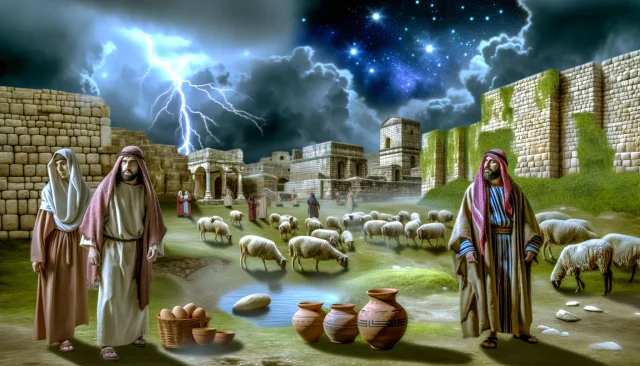
Lessons from Biblical Mothers and the Art of Nurturing

Godly Mother
The role of a mother in today's world can be overwhelming. The expectations are high, the challenges are many, and the societal pressures often feel relentless. A mother is not just a caregiver; she is a leader, a nurturer, a warrior in a battle for her children’s futures. In the midst of juggling work, family, and personal aspirations, she faces a crossroads moment. Should she prioritize career advancement or devote more time to her children's needs? The tension between professional growth and familial responsibilities is palpable. Add to this the weight of cultural norms that often dictate how mothers should act, and the dilemma intensifies. In this complex landscape, the question of what it means to be a Godly mother looms large.
The voices around us provide various perspectives. Some advocate for the traditional roles, while others push for a more modern interpretation of motherhood. The influence of social media amplifies this confusion, showcasing perfected images of motherhood that can be far from reality. Mothers are left wondering: how do they measure up? This complexity brings us to a pivotal question—what does Scripture say about godly motherhood? What examples can we draw upon to navigate these multifaceted challenges?
The Crossroads Moment
Consider the modern mother, working tirelessly to provide for her family while managing the emotional landscape of raising children. This scenario is filled with conflicting priorities. She sees her friends climbing the corporate ladder, yet her heart aches when she misses her child's first words or steps. Within this chaos, the notion of being a godly mother challenges her to balance her ambitions with her nurturing instinct.
Let’s take Sarah, a single mother living in the inner city. She wakes up at dawn to get her kids ready for school, then rushes to her job while constantly worrying about finances. She feels the pressure to be both the primary breadwinner and the emotional anchor for her children. One day, her teenage son gets into trouble at school. She must decide whether to confront him directly or to seek help from the community around her. This moment demands wisdom, strength, and a deep understanding of her parental role.
In another case, we have Maria, a mother of three, who is deeply involved in her church community. She embodies the qualities of Proverbs 31, but she struggles with feelings of inadequacy. She often compares her chaotic home life to the seemingly perfect ones portrayed online. As she scrolls through her feed, she battles the temptation to despair. Her crossroads moment arises when she must decide whether to prioritize her church commitments over her family's immediate needs. Here lies the call for wisdom in navigating the complexities of motherhood.
These are not just personal dilemmas; they represent the collective struggles faced by mothers today. The tension between aspirations and obligations, between personal fulfillment and familial duties, is a reality that demands a wise response.
Voices from the Cloud
To find clarity in this complex situation, we turn to the wisdom of Scripture. The voices of biblical mothers and wise figures echo through the ages, offering insights that resonate in our modern context.
First, we hear from Proverbs 31:26-27, which declares, “She opens her mouth with wisdom, and the teaching of kindness is on her tongue. She looks well to the ways of her household and does not eat the bread of idleness.” This passage emphasizes the dual role of knowledge and action. A godly mother speaks with wisdom and compassion, balancing her words with tangible care for her family. The challenge today is to embody this wisdom amidst the chaos.
Then we encounter the story of Hannah, found in 1 Samuel 1:27-28. “For this child I prayed, and the Lord has granted me my petition that I made to him. Therefore I have lent him to the Lord. As long as he lives, he is lent to the Lord.” Hannah's dedication to her son Samuel demonstrates a powerful act of faith. She prayed fervently for him and dedicated him to God's service. Her story reveals the importance of prayer and spiritual commitment, urging mothers to seek divine guidance in raising their children.
Another voice is that of Paul in 2 Timothy 1:5, where he commends Timothy for the faith that dwelled first in his grandmother Lois and his mother Eunice. This highlights the generational transmission of faith and values. A godly mother instills principles of faith, shaping the spiritual identity of her children and leaving a lasting legacy.
Lastly, we must consider the voice of Jesus, who told us in Matthew 19:14, “Let the little children come to me, and do not hinder them, for to such belongs the kingdom of heaven.” This invitation emphasizes the value of nurturing the spiritual lives of our children. It serves as a reminder that amid our striving, we m
Continue Your Bible Study
Explore more lessons and deepen your understanding of scripture
View All Lessons Ask AI a Question