Ezekiel Temple and the Blueprint for Broken Cities

Ezekiel Temple and the Fire of a Measured Future
The Beautiful Contradiction
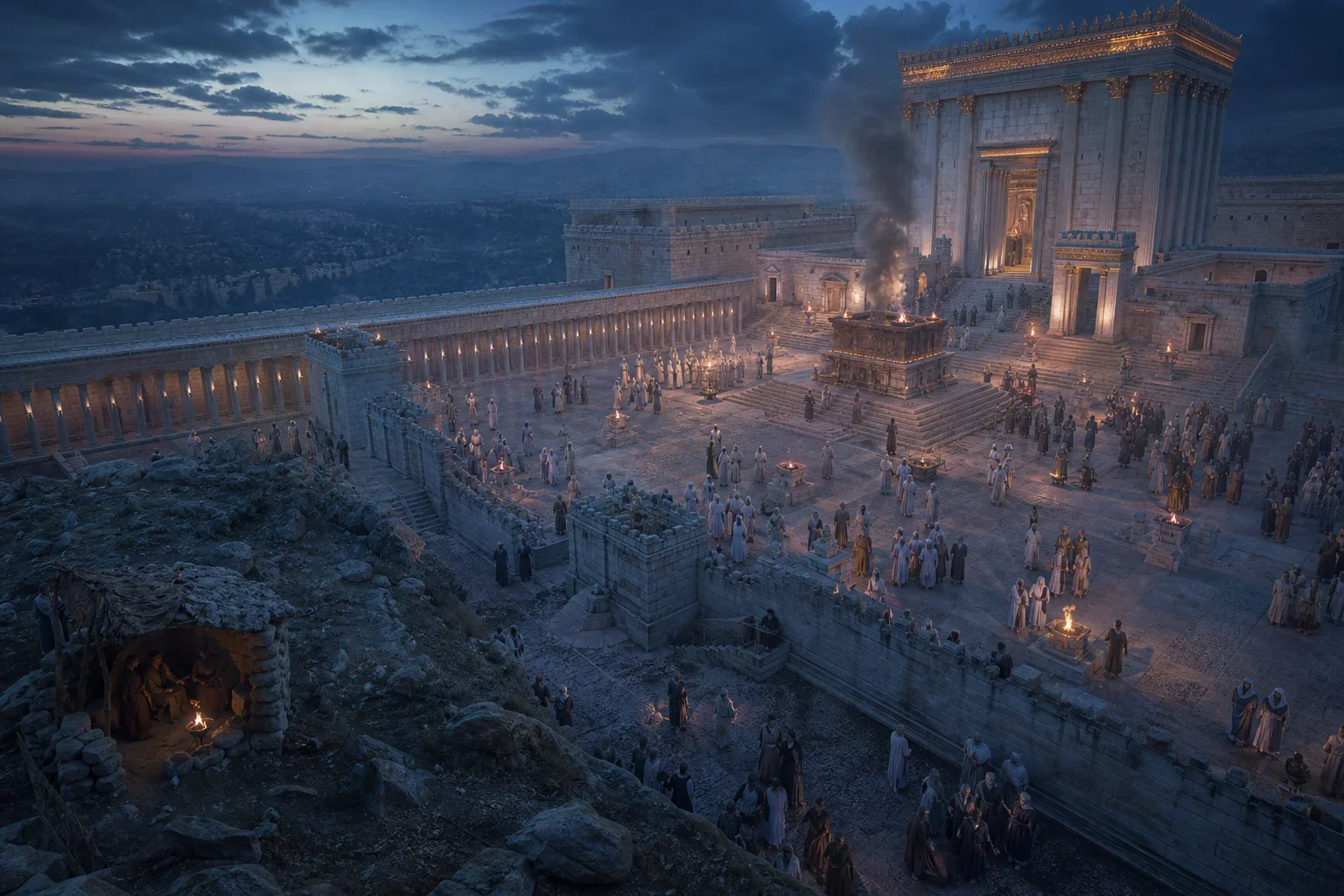
Ezekiel’s temple lands on you with a holy contradiction. It is measured down to the last gate, chamber, threshold, and courtyard, yet it burns with glory no measuring line can cage. It rises in a book born from exile, where the people had lost land, king, city, and sanctuary. A shattered nation receives blueprints. A displaced people receives boundaries. A community under judgment receives a vision thick with hope.
That tension matters. The temple is rigid and alive. Structured and overflowing. Local and cosmic. You read cubits and doorposts, priests and altars, walls and ordinances, and then the whole thing starts sounding larger than architecture. The kingdom demands more than comfort and more than vague spirituality. God is calling His church to wake up to a truth many have buried under private religion: holiness is not random, and presence is not cheap.
Ezekiel did not receive this vision while sitting in safety. He was among the exiles by the Kebar Canal, under imperial power, among traumatized people carrying grief in their bodies. I know something about that ache. I have stood in neighborhoods where mothers hold funeral programs with trembling hands, where police sirens cut through the night, where young men act hard because pain taught them early. In those streets, a measured future can feel offensive. Why talk temple when people are bleeding?
Yet that is the contradiction. God speaks design into devastation. He gives form to a people who feel formless. He marks sacred order in a world of chaos. Ezekiel 43:5 says, “The Spirit lifted me up and brought me into the inner court; and the glory of the Lord filled the temple.” Glory and geometry. Fire and measurements. Presence and policy. Where is the prophetic voice that can hold both?
And there is another paradox pressing hard against your chest. The temple looks separated from defilement, yet its purpose reaches beyond mere separation. It calls a broken people into nearness. It confronts sin while making space for restoration. An African proverb says when the roots are deep, there is no reason to fear the wind. Ezekiel’s temple is root work. It is God rebuilding the moral and spiritual architecture of a ruined people.
But here’s where it gets interesting:
Our Struggle with Mystery
You want Ezekiel’s temple to sit still. You want one clean label. Literal building. Symbolic vision. Millennial map. Spiritual metaphor. Something tidy. Something you can fold and place in a doctrinal drawer. But the text refuses to become your pet system. It keeps spilling over. It keeps confronting the modern addiction to instant clarity.
That struggle is not new. Exiles wanted restoration they could touch. Modern believers want application they can post in one line on Instagram. Seminary minds want categories. Activists want immediate social payoff. Pentecostal folk want fire. Institutional folk want order. Ezekiel’s temple stands in front of all these camps and says: God will not shrink to fit your preference.
I have felt that tension in my own bones. Years ago, I walked through a neglected block after a night of gunshots. Broken glass glittered under a flickering streetlight. A corner store metal shutter was half bent from an attempted break-in. A teenage boy I had been mentoring leaned against a brick wall, hoodie up, jaw tight, trying not to cry after his cousin got taken in a retaliatory shooting. In that moment, I did not need abstract religion. I needed a God who could enter wreckage and still speak order.
That is why Ezekiel’s temple disturbs you in the right way. It does not flatter your chaos. It confronts it. It says holiness has shape. Worship has boundaries. Leadership has accountability. Space matters. Practice matters. The Spirit is moving in the streets, yes, but the Spirit is not endorsing disorder dressed up as freedom.
Modern culture resists that word. You see it in traffic jams when one driver cuts across three lanes because patience feels beneath him. You see it in grocery store aisles when somebody curses out a cashier over rising egg prices, carrying financial stress but releasing it as cruelty. You see it in neighborhood conflicts where folks want peace without repentance, healing without truth, revival without discipline. Comfortable Christianity is dead Christianity, and chaotic Christianity is no better.
Ezekiel 43:10 says, “Son of man, describe the temple to the house of Israel, that they may be ashamed of their iniquities; and let them measure the pattern.” Hear that. The vision is not entertainment. It is moral confrontation. The pattern exposes distortion. The blueprint calls people to account. God is not handing out spiritual fantasy. He is summoning repentance.
You struggle with mystery because mystery removes control. If the temple is only a future building, you can postpone its demand. If it is only a symbol, you can domesticate it. If it is only about ancient Israel, you can keep your distance. The plot thickens:
Living the Paradox
Ezekiel’s temple starts breathing when you place it beside lives marked by holy tension. Not the usual polished examples. Not the saints edited for church anniversary brochures. I am talking about people who carried contradiction in their bodies. The temple belongs in that company because it comes to broken people with a vision too structured to be fantasy and too blazing to be mere engineering.
Take the returned exiles in Haggai’s day. They were rebuilding in weakness, facing economic strain, political pressure, and memory wounds. Haggai 2:9 declares, “The glory of this latter temple shall be greater than of the former, saith the Lord of hosts: and in this place will I give peace, saith the Lord of hosts.” Greater glory attached to a community with fewer visible resources. That is kingdom mathematics. God writes abundance over scarcity and dares you to believe while your pockets are light and your hands are dusty.
Then place Ezekiel’s temple beside the priestly word in Zechariah 6:12-13, where the Branch will build the temple of the Lord and bear royal honor. Priest and king in one figure. Governance and worship fused. Intercession and authority standing together. The temple is never merely a religious building. It is a sign that God intends to reorder public life under His rule. That should shake any church happy to sing on Sunday and ignore housing injustice on Monday.
And hear this lesser-known pulse from Ezekiel 44. The gate facing east remains shut because the Lord entered by it. Sacred memory becomes architectural policy. Presence leaves a mark on space. That confronts your life hard. If God has entered a place, a people, a body, then not every traffic pattern remains the same. Some doors close because glory passed through there. Some habits die because holiness has crossed the threshold.
I saw a glimpse of this with a brother named Tunde in our outreach work. He had gang ties, a scar running from his left cheek to his ear, and a laugh that could fill a basketball court. After prayer one winter evening in a church basement smelling of old coffee and radiator heat, he said, “I can’t go back to that apartment the same way.” He did not mean the furniture changed. He meant the gate had changed. Presence had marked the place. He started removing pills, burner phones, and a hidden pistol from that room. Temple logic had invaded a one-bedroom apartment.
That is where spiritual gifts and divine healing touch Ezekiel’s temple in a radical way. Gifts are not random fireworks. Healing is not a stage trick. In God’s economy, both serve the restoration of holy space. When the Spirit gives discernment, wisdom, prophecy, tongues, mercy, administration, or healing, He is not feeding religious ego. He is rebuilding a people fit for divine presence. He is restoring ruined chambers in human lives.
Look at 1 Peter 2:5: “Ye also, as lively stones, are built up a spiritual house, an holy priesthood, to offer up spiritual sacrifices, acceptable to God by Jesus Christ.” Living stones. Built up. Spiritual house. The New Testament does not erase temple reality; it intensifies it through Christ and His people. Your body, your fellowship, your shared life become contested sacred space. Where is the prophetic voice calling the church beyond performance into consecration?
Divine healing then becomes more than relief from pain. It is temple repair. A woman fighting lupus. A father carrying panic attacks after losing his job. A teenager numb from abuse. A neighborhood poisoned by fear after another police shooting. Healing in these places is kingdom reconstruction. Not every wound closes on your timetable. Not every miracle arrives in the same form. Yet when the Spirit moves, walls rise, altars are restored, and ruined rooms hear the sound of life again.
Now watch this:
The Hidden Unity
The unity inside Ezekiel’s temple vision emerges when you stop treating holiness and justice as enemies. Too many believers split what God has joined. One group talks purity and avoids the pain of the streets. Another talks liberation and treats holiness as a relic. Ezekiel will not permit that divorce. The temple is a political vision in priestly clothing. It is a holiness vision with public consequences.
Read the land arrangements, the prince’s limits, the priestly regulations, the guarded spaces. This is not random detail. It is divine resistance against corruption. In earlier chapters, leaders exploited people, idolatry polluted worship, and violence filled the land. The temple vision answers that rot with ordered nearness. God’s presence does not float above economics, leadership, or communal ethics. It confronts them all.
Ezekiel 45 presses this hard with honest weights, just measures, and restrained power. That matters in a world of predatory lending, wage theft, manipulated rents, and polished church empires built on exhausted volunteers. The kingdom demands more than comfort and more than charisma. If your worship space is loud with praise but your business practices crush the poor, your temple talk is a lie wearing choir robes.
There is deep wisdom here for spiritual gifts too. Gifts without temple order become spectacle. Healing without covenant becomes consumerism. Prophecy without holiness becomes manipulation. Administration without fire becomes bureaucracy. The hidden unity is this: the same Spirit who fills the temple also establishes pattern. Pentecostal power and disciplined obedience belong together. Fire needs an altar.
I think about neighborhood organizing meetings where everybody claims to want change, but no one wants shared rules, budgets, follow-up, or accountability. Passion alone cannot rebuild a block. You need vision, structure, trust, and moral clarity. In the same way, churches cry for revival while resisting the measured demands of God. They want the river without the temple, the glory without repentance, the gifts without the cross, the healing without the hard work of reconciliation.
Listen to Ezekiel 37:27, a word often overshadowed by the dry bones: “My tabernacle also shall be with them: yea, I will be their God, and they shall be my people.” That is the hidden center. Presence. Covenant. Belonging. The temple is not an end in itself. It is the architecture of communion under God’s reign. Measured space serves relational restoration. Holy order protects holy nearness.
An African proverb says the house roofed with strangers’ hands may leak in the first rain. God is not outsourcing the moral framework of His people to empire, trends, or celebrity culture. He is building a kingdom community from the inside out. That is why the temple vision still hits with force. It calls the church to become a healed, ordered, Spirit-filled people whose shared life rebukes the chaos of the age.
But here’s where it gets interesting:
Dancing with Mystery
You do not honor Ezekiel’s temple by flattening it. You honor it by letting it interrogate your life. Read it with your Bible open and your neighborhood in view. Read it with the smell of hospital disinfectant in your memory, with overdue bills on the kitchen table, with tension in your marriage, with grief from the last funeral still sitting in your chest. God is calling His church to wake up because sacred architecture is not detached from daily survival.
Start with prayer that invites measurement. Ask the Spirit to mark what in you belongs in the outer court and what must never enter the sanctuary. Ask where your inner gates stand broken. Ask what patterns in your speech, spending, sexuality, leadership, and anger dishonor holy presence. This is not performance. This is radical discipleship.
Practice communal healing, not isolated hype. If somebody seeks prayer for migraines, stay with them beyond the altar line. If a family is drowning in medical debt, organize meals, rides, childcare, and fundraising. If a young man keeps exploding in rage, pair deliverance prayer with counseling, mentorship, and accountability. The Spirit is moving in the streets, and the temple takes shape when gifts become sustained care.
Read lesser-known texts beside Ezekiel. Sit with 1 Chronicles 28, where pattern is given for sacred building. Sit with Zechariah 4, where temple work happens “Not by might, nor by power, but by my spirit, saith the Lord of hosts.” Sit with Revelation 21:22, where the Lord God Almighty and the Lamb are the temple of the city. The mystery widens. Sacred space moves toward full divine presence saturating all things.
Then carry temple consciousness into ordinary places. In the grocery store, refuse to spill your anxiety onto workers already under pressure. In a traffic jam on I-95 or the Lagos-Ibadan expressway, let restraint become worship. In neighborhood disputes over noise, parking, or trash, choose truth without contempt. In financial stress, reject the lie that desperation gives permission for exploitation. Temple people make holy decisions under heat.
And stay open to healing. Pray for bodies. Pray for minds. Pray for blocks. Pray in tongues if the Spirit gives utterance. Speak prophetic truth where death has become normal. Anoint with oil. Fast. Organize. Visit. Rebuke despair. Build support systems. Challenge unjust structures. This is not either spiritual or social. This is kingdom revolution.
Ezekiel’s temple leaves you with a living question, not a domesticated formula. Will you become space where glory can dwell without compromise? Will your church become a measured people in a disordered age? Will your gifts build rooms for healing or stages for ego? The river may not be named here, the final city may wait beyond this text, yet the summons is already at your door. Rise. Let mystery do its work. Let holiness breathe. Let presence rearrange the house.
Let this mystery sit in your spirit: where in your life do you feel the tension between craving God’s fire and resisting God’s pattern?
Where else in Scripture does sacred space, priestly order, and divine presence reshape your view of Ezekiel’s temple and the work of the Holy Spirit?
What within you reflects ruin that needs temple repair, and what gate must remain shut because the glory of God has passed through it?
Continue Your Bible Study
Explore more lessons and deepen your understanding of scripture
View All Lessons Ask AI a Question