Amos and Gods Call for Justice and Repentance

Amos at the Table of Justice and Mercy
The Empty Chair
Hunger has a sound. It is the microwave humming in a studio apartment at 10:47 p.m., the plastic fork scraping the bottom of a takeout container, the phone screen lighting up with notifications that still cannot fill the room. Picture yourself sitting at a small table under a weak kitchen bulb while rain taps the window, traffic hisses outside, and the second chair stays empty. Your stomach aches, yet something deeper aches more, because a full plate cannot quiet the loneliness that settles into your chest.
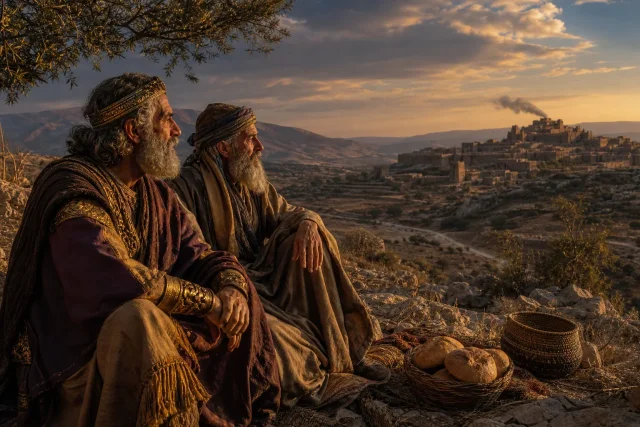
That scene gets close to Amos, even though he speaks from an ancient world of shepherds, baskets of summer fruit, and city gates. The prophet walks into Israel’s polished worship culture and pulls out the hidden truth: the nation is spiritually starving while pretending to feast. People recline on ivory beds, sip wine, and sing songs, but the poor are trampled, debt crushes families, and justice has vanished from the streets. History comes alive when we realize Amos is not yelling at outsiders; he is confronting religious people whose tables are loaded while their hearts are empty.
I think about students I have taught who eat lunch alone while everybody else laughs three tables over, and I think about adults scrolling grocery apps, calculating whether eggs, bread, and gas can all fit into one paycheck. You can feel isolated in a crowd, and you can feel spiritually hollow in a sanctuary packed with music and smiles. Amos names that split with sharp honesty. Amos 5:24 says,
“But let justice roll down like waters, and righteousness like an ever-flowing stream.”The prophet is saying that worship without mercy is a decorated table with no food on it.
At twenty, when my faith nearly collapsed, I felt that emptiness hard. I had Bible words in my head, but I needed reality, something with weight, texture, witness. Then I started seeing how the prophets speak into real streets, real corruption, real hunger. Amos does not float above life. He stands in dust and heat and calls out the lie that comfort equals blessing. The empty chair in Amos is not only about loneliness; it is also about the missing neighbor, the ignored widow, the worker who cannot afford what he stocks on the shelf.
Pull up a chair:
The Scandalous Dinner Guest
When you carry Amos into the Gospels, Jesus steps onto the scene as the guest who unsettles every safe seating chart. Picture a crowded first-century house at dusk, oil lamps flickering against rough plaster walls, sandals stacked by the door, voices overlapping, and religious leaders standing stiff in the corner with narrowed eyes. Jesus is not dining with the polished elite to protect His reputation. He is reclining with tax collectors, public sinners, and people respectable society has already written off.
That scandal matters for Amos because the prophet condemned a nation that used worship to hide exploitation. Jesus does something breathtaking: He confronts sin, yet He also sits down with sinners. He refuses fake holiness, and He refuses cold exclusion. Luke 5:31-32 says,
“And Jesus answered them, ‘Those who are well have no need of a physician, but those who are sick. I have not come to call the righteous but sinners to repentance.’”You can almost hear the room go quiet. The Holy One enters the mess, not to baptize injustice, but to rescue the unjust and the wounded together.
Amos cries out against those who sell the needy for a pair of sandals. Jesus walks into that world and starts rebuilding a people around mercy and truth. When He feeds the multitudes, this is not random crowd management. It is kingdom witness. Mark 6:41 records,
“And taking the five loaves and the two fish he looked up to heaven and said a blessing and broke the loaves and gave them to the disciples to set before the people. And he divided the two fish among them all.”The table expands in the wilderness. Scarcity does not get the last word when the King is present.
I love this as a history teacher because ancient tables were social maps. Who sat with you announced who belonged with you. Archaeologists have uncovered dining rooms in Roman houses where status literally shaped where bodies reclined. The stones cry out: meals were never just about calories. So when Jesus receives the unwanted, He is not making a small symbolic point. He is redrawing the map of belonging under the reign of God. That lands hard in your world when office lunch groups stay cliquish, when a church foyer feels colder than a DMV waiting line, or when a family conflict turns Thanksgiving into a battlefield of silence.
And then there is the Last Supper, where Jesus takes bread and cup on the night of betrayal. This is astonishing. He knows who will deny Him, who will run, who will sell Him out, and He still gives Himself. In that upper room, Amos and the Gospel meet. The prophet had thundered against religious performance detached from covenant faithfulness. Jesus now becomes the faithful One, the true Israelite, the Shepherd who provides what the failed people could not produce. Luke 22:19 says,
“And he took bread, and when he had given thanks, he broke it and gave it to them, saying, ‘This is my body, which is given for you. Do this in remembrance of me.’”
Picture the emotional weight in that room. Hands tremble. Eyes dart around. The air feels heavy, almost storm-thick. Jesus does not flatten Amos into a softer message. He fulfills the cry for justice by bearing judgment, and He opens a place at His table for those who repent and trust Him. That is why the scandalous dinner guest becomes the crucified host. He is not merely eating with sinners. He is making a way for sinners to be made new, so that worship and justice, mercy and holiness, finally sit at the same table.
Pass the bread:
Theology of the Table
Amos can sound severe until you place his words inside the whole biblical story. Then you realize his warnings are not petty rage; they are covenant grief. God formed a people to reflect His character in public life, in courts, in marketplaces, in harvest fields, in treatment of the vulnerable. When that calling collapses, the table collapses too. Communion with God was never meant to float above daily economics. If a family is crushed by fraud on Monday, songs on Saturday ring hollow. Amos is fierce because love is fierce when truth is being strangled.
That is where Jesus transforms your approach to Amos. He does not cancel the prophet; He brings the prophet to full light. At the Lord’s Table, bread and cup declare that communion with God comes only through the self-giving Messiah. Yet that same table exposes hypocrisy. Paul later warns believers not to eat in a manner that despises others. The meal of Christ is sacramental in the richest biblical sense: a visible proclamation that grace is costly, holiness is real, and reconciled people must not rebuild walls that the cross has torn down.
Amos 8:11 says,
“Behold, the days are coming, declares the Lord God, when I will send a famine on the land—not a famine of bread, nor a thirst for water, but of hearing the words of the Lord.”That famine still haunts modern life. You can stand in a bright grocery aisle under fluorescent lights, with cereal boxes stacked in perfect color order and apples misted to shine, and still be starved for the voice of God. You can sit in traffic on the 405, gripping the wheel, checking a banking app, carrying health test results in your glove compartment, and feel the soul-level drought Amos describes.
Communion answers that drought because Christ gives not a lecture alone, but Himself. Bread in your hand says the body of Jesus entered history, into dust, empire, violence, hunger. Cup at your lips says the new covenant is sealed through His blood, not your moral performance. History comes alive when we realize redemption is not an idea floating in the clouds. It is embodied, covenantal, communal, and future-facing. The table remembers Calvary, gathers the church in the present, and points ahead to the banquet where every false feast is exposed and every faithful longing is answered.
Picture the marriage supper imagery in Revelation with Amos still echoing in the background. The final feast is not built on exploited labor, hidden abuse, or polished worship masking cruelty. It is clean joy in the presence of the Lamb. That gives the Book of Amos a deeply personal relationship to Jesus. He is the Bridegroom who secures the feast by taking judgment on Himself. He is also the host who trains your appetite now, turning you away from counterfeit banquets of greed, status, and self-protection, and turning you toward righteousness that tastes of the coming kingdom.
The table is set:
Setting the Table
If Amos reaches your kitchen, your church hall, and your neighborhood sidewalk, then theology starts touching grocery carts and calendars. Picture a Saturday afternoon at H-E-B or Kroger, carts rattling over tile, a toddler crying near the frozen pizzas, a weary nurse still in scrubs comparing prices on chicken thighs, rice, and canned beans. Amos asks what justice looks like there. Do you notice the single dad counting coupons twice? Do you pay fairly, tip generously, and refuse the little habits of indifference that train your heart to step over people?
When Jesus reshapes your reading of Amos, actual tables become places of truth and mercy. Maybe your apartment is tiny, with mismatched chairs and a table scarred by homework, bills, and coffee rings. That can still become holy ground. Invite the college student far from home, the widow from church who dreads evenings, the neighbor you only wave at while dragging trash bins to the curb on Tuesday mornings. The point is not polished entertaining. The point is making room in concrete, embodied ways that mirror the welcome you received from Christ.
I think about church potlucks because, honestly, they can be awkward, wonderful, and revealing all at once. Aluminum trays sweat under cafeteria lights, kids sprint past folding tables, somebody’s mac and cheese disappears first, and somebody else stands alone balancing a paper plate and a Styrofoam cup. Amos would ask who gets overlooked in that room. Jesus would move toward that person. The gospel trains your eyes to notice body language, silence, and small hesitations. A table shaped by Christ resists invisible hierarchies and moves toward the person who assumes nobody saved a seat.
And this reaches beyond church events. In traffic jams, when a delivery driver cuts you off and your coffee sloshes onto your center console, Amos presses on your impatience because justice starts in the heart before it appears in systems. In relationship conflicts, when text bubbles sit unanswered and resentment starts writing speeches in your head, Christ calls you toward truth without contempt. In financial stress and health concerns, when fear narrows your world to survival mode, the Lord still forms you into someone who keeps a place open for others. That is table theology with work boots on, phone charger tangled in the cup holder, and dinner simmering on a weeknight stove.
Pass the bread:
Foretaste of the Feast
Amos ends with restoration, and that matters more than many people realize. After all the thunder, there is promise. Amos 9:13 says,
“Behold, the days are coming, declares the Lord, when the plowman shall overtake the reaper and the treader of grapes him who sows the seed; the mountains shall drip sweet wine, and all the hills shall flow with it.”Picture abundance so rich that harvest crowds into planting season, vineyards overflow, and the land itself seems to sing. The prophet of judgment is also a witness to hope.
That hope finds its center in Jesus. He takes Amos’s warnings into His own body at the cross and rises to secure Amos’s restoration for all who belong to Him. So every faithful earthly table becomes a preview trailer, a cinematic glimpse of the coming kingdom banquet. Not the full film yet, but enough to make your heart ache in the best way. You taste bread, hear laughter, watch an elderly saint bow her head in prayer, and for a moment the future leans into the present. The kingdom is not complete, but it is already breaking in.
Picture a wedding reception under warm string lights in a community hall after a hard season. A couple who survived layoffs, doctor visits, and family tension now stand smiling through tears while cousins pass plates, children dance badly and beautifully, and older hands clap to the beat. That scene carries a whisper of the greater feast. Isaiah and Revelation join Amos here: the Lord prepares abundance, wipes away tears, and welcomes His people into joy that no corruption can poison. New wine belongs to the age to come because the Bridegroom has arrived.
As a guy who once wrestled hard with doubt, I treasure that Christianity is not escapist vapor. The archaeological evidence tells us our faith is rooted in real places, real meals, real bodies, real history. I remember standing near ancient ruins on a dig, dust on my boots, sun burning the back of my neck, holding pottery fragments and thinking, these people cooked, grieved, celebrated, waited. The Bible speaks into that world and into yours, where group chats go silent, MRI results take too long, rent climbs, and neighbors carry groceries up dim apartment stairs. Christ meets you there and points you forward.
So the Book of Amos is not merely a warning siren from a distant century. It is an invitation to hunger for the right feast. Set a table with open hands. Extend an invitation that carries the aroma of grace and truth. Pray for the day when the Lamb welcomes His people and every empty chair meant for the redeemed is filled. Lord Jesus, train our appetites for justice, mercy, and Your presence. Keep us from counterfeit banquets. Make our homes, churches, and ordinary weekdays echo the coming feast.
Relational: How could your community embody the truth of Amos and Jesus by making room for the overlooked person in a concrete, visible way this week?
Action: Who will you invite to your table in the next seven days, especially someone carrying financial stress, grief, or quiet isolation?
Contemplative: Rest in this tension: where has your worship become polished while your heart resists the justice and mercy that Christ loves?
Continue Your Bible Study
Explore more lessons and deepen your understanding of scripture
View All Lessons Ask AI a Question