The Intertestamental Period and the Making of Judaism

The Intertestamental Period Between Prophets and Gospel
Waiting for a Prophet
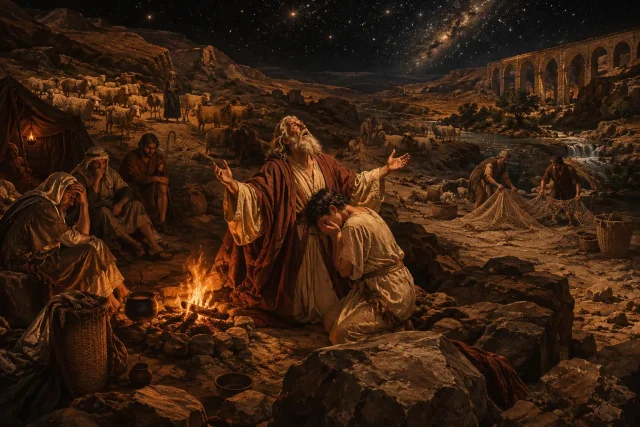
Jerusalem mourns a desecrated sanctuary, families torn apart, and the loss of worship under a foreign ruler. In the second century BC, the author of 1 Maccabees describes the city’s humiliation in the language of a funeral; priests groan, young women grieve, and the land itself seems to tremble. You enter the intertestamental period through a record of actual political and religious injury, not through an empty space between two Bible pages.
The phrase intertestamental period commonly refers to the centuries between the Old Testament’s latest writings and the events of the New Testament. Its boundaries are approximate: Malachi is usually placed in the fifth century BC, while Jesus is born near the end of the first century BC. Calling these centuries “silent” can be misleading, since Jewish communities produced histories, prayers, translations, and interpretations throughout them.
First Maccabees does record an expectation that a trustworthy prophet would eventually arise. After the temple is cleansed, its damaged altar stones are stored until a prophet can decide what to do with them, according to 1 Maccabees 4:44–46. The stones make a memorable classroom image: loss is acknowledged, a practical decision is postponed, and a community waits for authoritative direction.
Malachi’s closing words place prophetic expectation beside family and national accountability. Malachi 4:5–6, in the King James Version, reads:
“Behold, I will send you Elijah the prophet before the coming of the great and dreadful day of the LORD: And he shall turn the heart of the fathers to the children, and the heart of the children to their fathers, lest I come and smite the earth with a curse.”
You can hear neither a promise of an easy century nor permission to pretend that harm has vanished. The passage anticipates God’s intervention while naming the danger of judgment and broken relationships. That seriousness gives you room to read later Jewish mourning without treating it as a failure of faith.
Christian readers also encounter lament in the psalms and in Jesus’ response to death. John 11:35 states, “Jesus wept.” The Gospel account is centuries later than the Maccabean crisis, yet it resists the same pressure to cover sorrow with cheerful slogans; grief can be spoken plainly in the presence of God.
Empire and the Language of Loss
Yet even here: the historical record requires careful dates before theological conclusions. Judea begins this period under Persian rule, with the Second Temple standing in Jerusalem after its completion around 516 BC. Alexander the Great defeats the Persian Empire in the fourth century BC, and after his death in 323 BC his successors divide his territories.
Greek language and culture spread across the eastern Mediterranean, though their influence varies by place and community. Judea comes under the Ptolemies of Egypt and then, around 200 BC, under the Seleucids, whose kingdom includes Syria. You can trace these changes on a map rather than assuming that every Jewish person responds to Greek culture in the same way.
Greek-speaking Jewish communities also produce the Septuagint, a Greek translation of Jewish Scripture whose earliest books were translated in the third century BC. Its formation takes place over time, and the collection’s contents vary across manuscripts and traditions. When New Testament writers quote Scripture in Greek, this translation tradition often forms part of the background.
The crisis sharpens under Antiochus IV Epiphanes, a Seleucid ruler. In 167 BC, according to the Maccabean accounts, royal measures attack Jewish practices, including circumcision and Sabbath observance, and the Jerusalem temple is profaned. Ancient sources present these events from particular perspectives, and historians debate details and causes, including the role of conflicts among Judean elites.
First Maccabees responds with a communal lament in chapter 1, describing Jerusalem as bereaved and its sanctuary as desolate. Its complaint names the sanctuary, the priests, the people, and the foreign power; it does not reduce political violence to an unnamed feeling. You can use that pattern when reading other laments: identify the speaker, the loss, the accused, and any request addressed to God.
The Psalms of Solomon, a Jewish collection generally dated to the first century BC, offer another witness to loss. Their poems connect Jerusalem’s suffering with both foreign domination and criticism of the city’s own leaders, particularly around the period of Roman intervention. They are not the same work as the biblical Psalms, and their authorship is not securely known.
For a practical reading exercise, place 1 Maccabees 1 beside Psalm 79 and mark the references to the temple, the nations, and public disgrace. Psalm 79 belongs to an earlier setting of Jerusalem’s devastation, so the texts should not be collapsed into one event. Their shared vocabulary helps you see how later writers drew on inherited language to give a fresh crisis a name.
Faithfulness under Pressure
Something shifts: resistance to Antiochus becomes organized around the priest Mattathias and his sons, including Judas Maccabeus. First and Second Maccabees recount overlapping events with different emphases; the former gives a broadly chronological political narrative, while the latter emphasizes divine justice, martyrdom, and the temple. Neither should be treated as a neutral transcript, yet both are indispensable witnesses to the period.
Judas and his allies retake Jerusalem’s temple and rededicate it in 164 BC. The annual festival of Hanukkah commemorates that rededication; John 10:22 later places Jesus in Jerusalem during the Feast of Dedication. The familiar account of a small supply of oil lasting eight days appears in later rabbinic tradition, rather than in the original rededication account in 1 Maccabees.
Second Maccabees 7 tells of a mother and seven sons who refuse to violate their ancestral law and are tortured and killed. The chapter connects their endurance with confidence that God can raise the dead, giving you a concrete setting for Jewish debates about resurrection. Its account deserves sober attention: these people are not background figures in someone else’s sermon, and their deaths are not made insignificant by later victories.
Daniel’s visions also matter for this setting, though scholars differ over the book’s dating and the relationship between its visions and second-century events. Many scholars read portions of Daniel against the persecution under Antiochus; traditional evangelical readings often regard the visions as earlier prophecy. Daniel 12:2, King James Version, states:
“And many of them that sleep in the dust of the earth shall awake, some to everlasting life, and some to shame and everlasting contempt.”
For Christians, this expectation belongs within a larger biblical story that includes the resurrection of Jesus. The historical claim that people hoped for resurrection is distinct from the theological claim that Jesus fulfills God’s promises; each deserves careful treatment. Daniel’s language of judgment also resists a shallow account in which every act of resistance is automatically righteous.
The archaeological evidence tells us that the world of these accounts had recognizable streets, coins, and fortifications, though objects rarely settle every disputed detail. At Maresha in southern Israel, excavated houses, underground spaces, and inscriptions bear witness to a culturally mixed Hellenistic city. A coin bearing a ruler’s image can establish political claims and chronology; it cannot, by itself, verify a miracle or tell you what every resident believed.
In a classroom, you might compare a photograph of a Seleucid coin with the written account of Antiochus and label what each source can actually support. The exercise is useful beyond ancient history: when a neighborhood dispute appears in a local newspaper and on a resident’s phone recording, each source has a viewpoint and a limited frame. Responsible reading does not demand that you abandon conviction; it asks you to distinguish evidence from inference.
Rulers Priests and Jewish Communities
Watch what happens: the Maccabean victory does not end Judea’s political complications. The Hasmonean family, descended from Mattathias, gains priestly and political authority, and Judea experiences a period of substantial independence. Its rulers also fight internal rivals and expand their territory, leaving a record more complicated than a simple contrast between faithful Judeans and foreign oppressors.
In 63 BC, the Roman general Pompey intervenes in a Hasmonean succession dispute and takes Jerusalem. The Psalms of Solomon reflect outrage at Jerusalem’s defilement and anticipate a righteous Davidic ruler, especially in Psalm 17. Their expectation helps you hear the political force of the title “Son of David” in the Gospels without assuming that every first-century Jew expected the same kind of deliverer.
Herod the Great later rules as a Roman client king from 37 to 4 BC. His enormous rebuilding of the Jerusalem temple complex begins around 20 or 19 BC, placing the temple encountered in the Gospels within a recognizable building history. Surviving retaining walls and other archaeological remains illuminate the scale of the complex, while the temple building itself was destroyed by Rome in AD 70.
Second Temple Judaism includes varied communities and interpretations rather than a single religious party. Pharisees, Sadducees, and groups associated by many scholars with the Dead Sea Scrolls differ on matters of law, leadership, purity, and future hope. Ancient sources about these groups have their own agendas, so a reader should avoid turning any group into a caricature.
The Dead Sea Scrolls, found beginning in 1947 near Qumran, include biblical manuscripts and other Jewish writings, many copied during the intertestamental centuries. They offer evidence for the transmission and interpretation of Scripture, as well as the concerns of the community or communities connected with the collection. Their presence does not prove every later Christian claim, but it gives you tangible witnesses to Jewish textual life before and around the time of Jesus.
Synagogues and Jewish communities across the Mediterranean also form part of this world. By the first century AD, Acts portrays Scripture being read and discussed in synagogues in several cities, though the origins and functions of individual synagogues varied. When Paul enters those settings, he is addressing communities with established practices, not audiences appearing suddenly on the New Testament stage.
Reading the Gospel with History in View
The gospel places Jesus within this Jewish and Roman world rather than above its history. Luke introduces John the Baptist in relation to rulers, priests, and the expectation associated with Elijah; Christians read that account alongside Malachi’s closing promise. Jesus’ ministry also unfolds amid temple worship, debate over the law, Roman power, and hopes shaped by centuries of Jewish interpretation.
Mark 1:15, King James Version, records Jesus’ announcement: “And saying, The time is fulfilled, and the kingdom of God is at hand: repent ye, and believe the gospel.” The declaration gains historical depth when you know that different Jewish groups had long awaited God’s decisive rule. The gospel does not erase those hopes; it calls readers to assess Jesus’ announcement, death, and resurrection in relation to them.
Christians differ over the status of books written during these centuries. Protestant Bibles ordinarily place books including 1 and 2 Maccabees outside the biblical canon, while Catholic and Orthodox traditions include them in their Old Testament collections, with some differences among Orthodox canons. Even when you read these works as historical sources rather than Scripture, they provide valuable evidence for Jewish belief, worship, and political memory.
That distinction can guide a study group meeting after work around a kitchen table, with a grocery receipt beside an open Bible and a museum photograph on a phone. Read a Gospel passage, identify its historical setting, and then consult a dated primary source or a reputable museum catalogue. A family facing rising food prices or a difficult medical bill does not need an artificial comparison with ancient persecution; the disciplined habit worth carrying home is naming a situation accurately before making claims about it.
Acts extends the biblical story into cities shaped by Greek language, Roman administration, and Jewish communities of the diaspora. Christian praise in that setting rests on the conviction that the crucified Jesus has been raised, not on a claim that imperial violence or human sorrow has disappeared. You can praise God with the evidence and the wounds both in view, remembering the mourners of Jerusalem as well as the witnesses who proclaim resurrection.
Questions for Reflection
Introspective: Where are you tempted to replace a careful account of someone’s loss with a reassuring statement that asks too little of you?
Contemplative: As you sit with the stored altar stones in 1 Maccabees, what do their preservation and the community’s waiting bring to your attention?
Theological: How does reading Jesus’ announcement of God’s kingdom alongside Jewish hopes from the intertestamental period shape your view of the gospel’s place in the biblical story?
Continue Your Bible Study
Explore more lessons and deepen your understanding of scripture
View All Lessons Ask AI a Question