The Mosaic Covenant and Gods Promise to His People

The Mosaic Covenant and the God Who Holds His People
When Everything Falls Apart
The fluorescent lights hum above the conference table as Maya reads the email again. Her engineering job at a Seattle software company ends today, and her manager slides a severance packet across the polished wood. Outside, rain streaks the windows; inside, her phone lights up with a reminder that her son needs a prescription refill. She folds the packet once, then presses its sharp edge against her palm.
At the grocery store that evening, Maya stands beneath the cold glow of the dairy case, comparing prices on two cartons of milk. Her calculator app is open beside a list that includes rent, insulin, and the electricity bill. A neighbor waves from the next aisle, but Maya keeps her eyes on the shelf. She is not ready to explain why a routine purchase now feels like a mathematical proof with missing variables.
Her husband asks whether she has contacted recruiters, and the question lands harder than he intends. They argue beside the sink while traffic crawls past their apartment windows and a siren rises somewhere down the street. Their daughter hears the raised voices and quietly closes her bedroom door. Financial stress has entered the family system, altering conversations that once felt safe.
A job loss does not erase every responsibility, and it does not give anyone permission to wound the people nearest them. Yet the demand to perform can become merciless when security seems tied to productivity. Maya knows the rhythm of a workplace dashboard: green indicators mean success, red indicators mean intervention. She begins measuring herself by the same framework, treating every anxious thought as evidence of failure.
The Mosaic covenant enters this scene from a surprising direction. Before Israel receives commandments at Sinai, God hears enslaved people crying under a crushing labor system. He acts as their deliverer before he addresses them as a nation called to obedience. That sequence does not make obedience optional; it places human responsibility within the prior action and sovereign purpose of God.
Maya cannot calculate the date of her next offer or guarantee that her family will avoid hardship. She can bring her fear before the Lord, speak honestly with her husband, and accept help without treating dependence as disgrace. The covenant pattern gives her a sturdier foundation than a performance score. It directs her attention toward the God who governs history and calls his people to live faithfully within it.
Ancient Cries, Timeless Pain
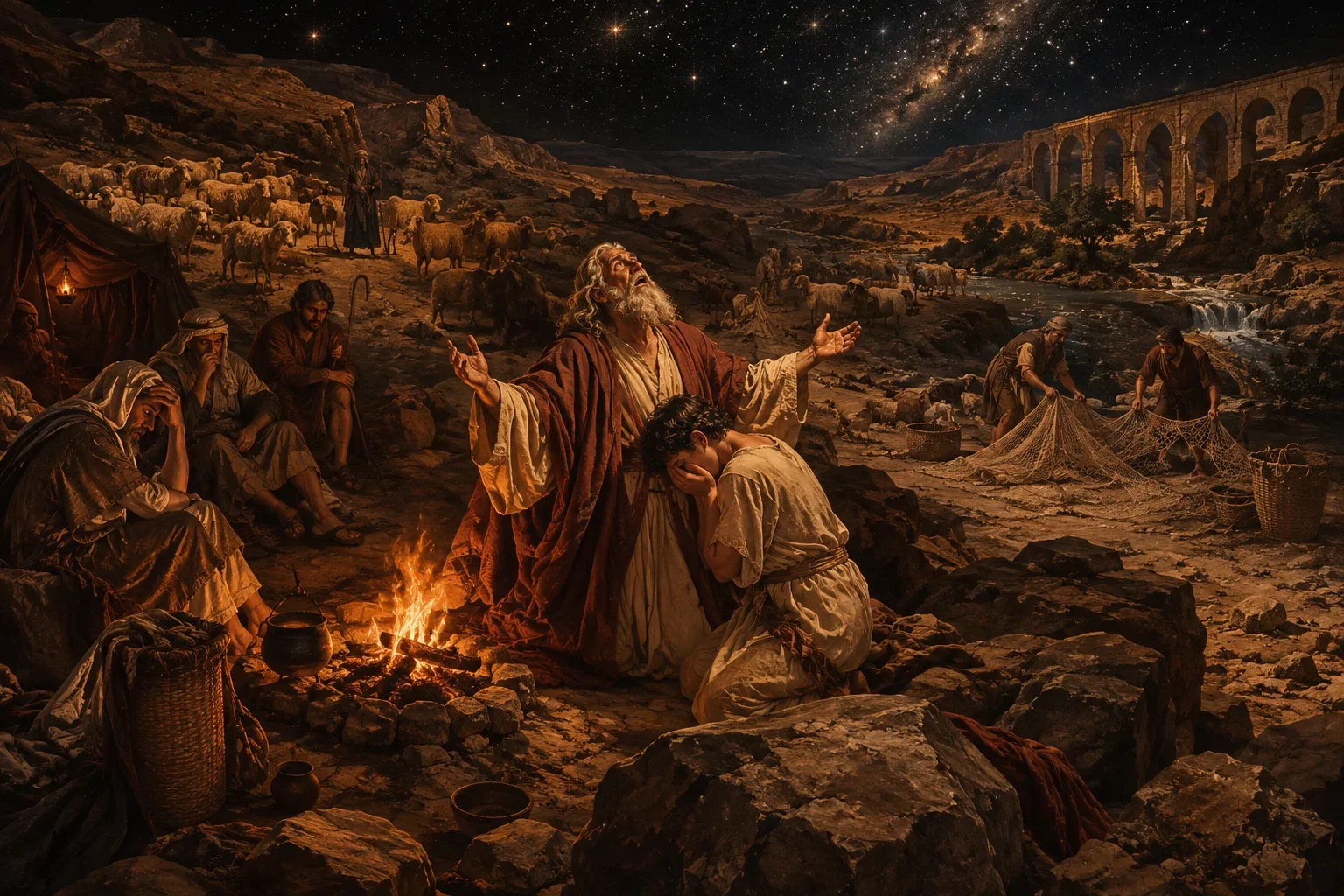
Because of this, we turn toward Egypt, where Israel's crisis has a public structure and a deeply personal cost. Pharaoh commands that Hebrew infants be killed, and Israelite workers are forced to meet production targets under threat of punishment. Exodus places family grief beside economic exploitation; the machinery of empire reaches into cradles and brick fields. The people cry out, and their cries rise to God amid the noise of forced labor.
Exodus 2:24 says, “And God heard their groaning, and God remembered his covenant with Abraham, with Isaac, and with Jacob” (KJV). God does not remember because information has slipped from his mind. In the biblical pattern, his remembering signals faithful attention to a promise and action consistent with it. The covenant with Abraham forms the foundation beneath the rescue that leads Israel toward Sinai.
Moses himself knows displacement, fear, and reluctance. Raised in Pharaoh's household, he later flees Egypt after killing an Egyptian and spends years in Midian before God calls him from the burning bush. His objections are specific: Who is he to confront Pharaoh, and what will he say? God answers with his presence and his name, rather than supplying Moses with a guarantee of personal ease.
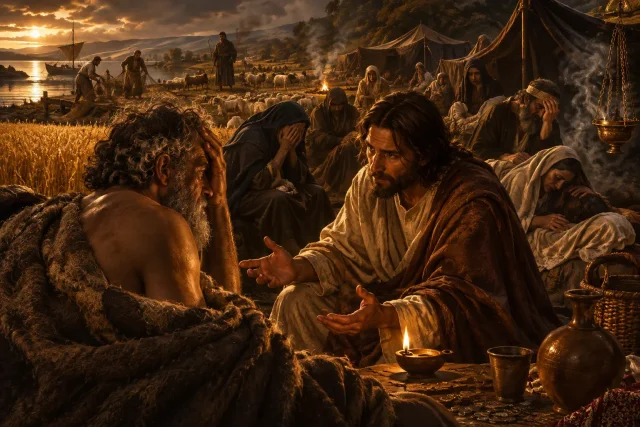
Other biblical voices inhabit terrain that reaches across centuries. Job loses children, livelihood, and health, then speaks from the dust without receiving a tidy explanation for each wound. David cries out over betrayal by a close companion in Psalm 55, a pain sharpened by shared trust. Hannah weeps over her childlessness and pours out her soul before the Lord in 1 Samuel 1, while another woman provokes her.
These accounts are not interchangeable, and none should be reduced to a formula for securing a desired outcome. Job's suffering is not presented as punishment for a secret offense, and Hannah's story does not promise every grieving woman a child. Their cries belong to particular histories, yet each exposes the vulnerability of people who cannot control what matters most. Scripture gives those cries room instead of demanding polished religious language.
At Sinai, the people who have crossed the sea carry memories of slavery into a new life. Freedom from Pharaoh does not instantly remove fear, conflict, or the temptation to seek visible substitutes for God. Their complaints in the wilderness and their worship of the golden calf reveal hearts still prone to distrust. Their story asks us to consider not only the systems that oppress people, but also the loyalties that shape a rescued community.
Notice the pattern here: divine sovereignty never makes human tears irrelevant. The Lord hears, remembers, delivers, and then speaks to a people who must respond. Their humanity remains visible throughout the narrative, as does his steadfast purpose.
The Unbreakable Promise
This changes everything: Sinai is not the beginning of God's relationship with Israel. The Lord has promised Abraham descendants, land, and blessing extending to the nations in Genesis 12 and 15. He brings Israel out of Egypt in keeping with that earlier covenant, then establishes the Mosaic covenant with the redeemed nation. Covenant theology reads these events as interconnected stages in God's unfolding purpose, not isolated religious programs.
Exodus 19:5 says, “Now therefore, if ye will obey my voice indeed, and keep my covenant, then ye shall be a peculiar treasure unto me above all people: for all the earth is mine” (KJV). The word translated “peculiar treasure” renders the Hebrew segullah, a treasured possession. The condition is real: Israel is summoned to obey, and the covenant includes blessings and curses tied to its national life. God's ownership of all the earth frames that calling within his sovereign rule.
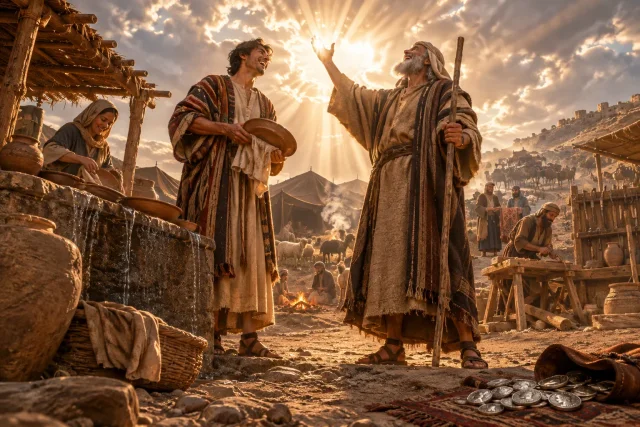
Exodus 19:6 continues, “And ye shall be unto me a kingdom of priests, and an holy nation. These are the words which thou shalt speak unto the children of Israel” (KJV). Israel's vocation has a public dimension: a people set apart for God, bearing witness among the nations. Priests serve in relation to God's presence, and the nation as a whole is called to reflect his holiness. The commands that follow concern worship, family, property, justice, and care for vulnerable neighbors.
The sequence matters as much as the content. Exodus 20:2 says, “I am the LORD thy God, which have brought thee out of the land of Egypt, out of the house of bondage” (KJV). Only after that declaration does the Decalogue begin its commands. Israel does not earn release from Egypt by keeping the law; the rescued people receive instruction for life under their Redeemer's rule.
Yet the golden calf exposes the depth of Israel's rebellion almost immediately. Moses intercedes, the Lord judges, and God renews his covenant dealings with the people in Exodus 32 through 34. Later, the prophets announce judgment for persistent covenant breaking and promise a new covenant in which God will write his law on his people's hearts and forgive their sins. Jeremiah 31:31–34 carries that promise forward without pretending Sinai's commands were defective.
Jesus brings this covenant history to its appointed fulfillment. At the Last Supper he identifies his blood with the new covenant, and Hebrews presents his priesthood and sacrifice as the decisive provision anticipated by the earlier covenant's sacrificial system. Christians disagree about details of covenant continuity, yet the Reformed framework insists that salvation rests on God's grace in Christ, never on human law keeping. The Mosaic administration prepares the way for him while revealing the holiness of God and the seriousness of sin.
For Maya, the promise is not an immediate job offer or freedom from every medical bill. In Christ, God's people receive forgiveness, access to him, and the Spirit's renewing work. Sovereign grace establishes the foundation; responsible obedience grows from union with the Redeemer.
The Sacred Transformation
Here's where it gets revolutionary: covenant trust is not a switch that makes fear disappear. It is a pattern of returning to God's character while taking the next responsible step. Israel had to gather manna each morning rather than store unlimited security, and Maya must address actual bills rather than deny them. Dependence and action belong together, even when the next month remains uncertain.
Begin with prayer that names the facts. Maya can place the severance letter on the kitchen table, tell God what she fears about rent and medication, and ask for wisdom without claiming a timetable he has not promised. She can pray through Exodus 20:2, thanking the Lord for his saving action before examining her own failures. Confession then becomes a return to a merciful Redeemer, not an attempt to purchase his attention.
Next, bring the crisis into a trustworthy community. A friend can sit with Maya at the library, review her résumé on Google Docs, and help her contact a local benefits counselor about prescription coverage. Her husband can name the strain he carries, apologize for a cutting remark, and help build a realistic budget. These actions do not replace prayer; they give concrete form to neighbor love and shared responsibility.
Read the Mosaic law in its original setting before drawing a line to a modern decision. Israel's Sabbath, land laws, and sacrificial regulations belonged to a covenant made with a particular nation, and their application to Christians must be considered in light of Christ. The command to protect the vulnerable still presses questions upon employers, neighbors, and families. Grace does not erase moral seriousness; it directs obedience toward love of God and neighbor.
Think of a software system whose access privileges are granted by an administrator, not manufactured by a user's keystrokes. The user's actions still matter within the system, but they are not the source of the original authorization. The analogy has limits: God is personal, and covenant is not a machine. Still, it helps distinguish the foundation of grace from the genuine responsibilities that follow.
When fear returns, Maya can repeat a simple prayer: “Lord, you are sovereign; make me faithful today.” She can also rest, seek professional medical care when needed, and refuse the assumption that every setback signals divine rejection. The Spirit forms patience through ordinary acts, including listening before answering and asking for help. Covenant trust grows not by controlling every variable, but by living before the God who holds them all.
Living as Covenant People
Because of this, daily life becomes a place for covenant faithfulness rather than a test of whether we can secure our own worth. A nurse finishing a night shift can speak honestly about exhaustion and accept a colleague's offer to cover a task. A parent stuck in traffic on Interstate 5 can call to apologize for being late rather than turn frustration into a harsh greeting at home. Neither act earns God's favor; each can express love shaped by grace.
Consider a composite testimony drawn from common circumstances: a warehouse worker faces reduced hours, and her Bible study group helps her compare utility assistance programs. One woman brings groceries; another checks in after the worker's medical appointment. The worker later says that receiving help challenged her pride as much as giving help had once strengthened her sense of competence. Her circumstances remain difficult, but isolation no longer writes the whole story.
At the neighborhood level, covenant-shaped responsibility asks who bears the cost of a system. Residents at an apartment meeting can question a proposed fee that would fall hardest on families already behind on rent. A manager can audit scheduling software for patterns that repeatedly assign unstable hours to the same workers. God's sovereignty does not excuse passive acceptance of injustice; it frees his people to act without pretending they control every outcome.
The law's pattern reaches beyond private morality toward worship and neighbor love. Its sacrifices point forward to Christ, while its commands expose our need for mercy and instruct redeemed people in God's character. We read the whole framework through the death and resurrection of Jesus, not by placing Christians back under Israel's national covenant. The promised Spirit writes God's will on hearts and gathers a people from many nations.
My declaration: My security rests in Christ, not in my productivity, and I will seek to obey the Lord who has redeemed me. Covenant prayer: Faithful Father, forgive our distrust, provide for those in need, and make us courageous in love. Your prophetic promise stands: you will be our God, and we will be your people.
Introspective: Where does fear of failure make you treat obedience as the price of God's acceptance?
Action: What workplace or neighborhood system will you examine this week for burdens placed on vulnerable people?
Prophetic: What pattern of empire must your community resist as it bears witness to Christ's coming kingdom?
Continue Your Bible Study
Explore more lessons and deepen your understanding of scripture
View All Lessons Ask AI a Question