Pursued by Grace in Psalm 139 and Jonah

Hound of Heaven in the Dark Streets of Ordinary Life
Shadows at Noon
The email arrives at 12:14 p.m. while fluorescent lights hum over a break room sink streaked with old coffee. A hospital billing app flashes another payment reminder on a cracked phone screen. Down the hall, a manager clears his throat and avoids eye contact. In the grocery store later, under the hard white light near the freezer aisle, a mother studies the price of eggs, puts one carton back, and presses her lips together so she will not cry in front of her son.
Traffic thickens at the overpass. Brake lights burn red in the rain, and a man in the next lane pounds his steering wheel after a text from his wife that reads, We need to talk tonight. In a brick duplex across town, an inhaler rattles on a nightstand beside an unpaid electric bill and a bottle of pills with a childproof cap. In the midst of chaos, God whispers, though many hearts do not hear Him because panic is loud and shame is louder.
The phrase Hound of Heaven can sound severe to modern ears, almost harsh, until life strips away the pretty language we use for grace. Francis Thompson gave the Church a vivid image: God pursuing the fleeing soul, not with cruelty, but with covenant love that refuses to abandon what He has claimed. I think of that pursuit in ordinary places, not only in monasteries or poetry books, but in oncology waiting rooms, crowded school pickup lines, and kitchen floors sticky with spilled juice. The kitchen table became an altar when I began to see that divine pursuit often arrives disguised as interruption.
Many of us were taught to expect God in consolations, in answered prayers that feel clean and immediate. Yet Scripture keeps placing Him in the path of those who run, hide, bargain, numb themselves, or sink into anger. This is not sentimental religion. This is the holy persistence of the Lord who will not reduce covenant to a polite invitation.
Because of this, the darkness of contemporary life must be named plainly. Financial stress clenches the jaw and shortens every conversation. Relationship conflict turns a living room into a battlefield of silence, where the television stays on only to cover what no one wants to say. Health concerns rearrange a family calendar overnight, and even Sunday Mass can feel heavy when one child has a fever, another is struggling with anxiety, and the marriage itself feels thin as paper.
I write as a woman who once measured worth by performance and applause, and then found myself between diaper changes and dishes, face to face with a quieter crisis. My vocation as mother teaches me that people do not always run from God by partying in the streets. Sometimes we run by controlling, by pleasing, by keeping every surface wiped down while the soul trembles underneath. Finding Christ in the mundane means admitting that His pursuit enters exactly there.
Ancient Pursuit and the Cry of the Fleeing Heart
The most fitting biblical companions for this theme are not always the ones most commonly quoted in seasons of pain. Jonah, Jeremiah, and the psalmist give us a deeper grammar for divine pursuit. They stand in that strange place where human resistance meets prevenient grace, the grace that moves first, the grace-filled initiative of God before we manage a noble response.
Jonah does not merely hesitate; he attempts escape. He pays a fare, boards a ship, and chooses distance. The text does not present a God wringing His hands over human freedom. It presents the Lord acting within history, sea, storm, pagan sailors, a great fish, and a prophet’s own body. The pursuit is cosmic and intimate at once. It reaches weather patterns and conscience in the same breath.
Jonah 1:3 “But Jonah rose to flee to Tarshish from the presence of the Lord. He went down to Joppa and found a ship going to Tarshish; so he paid the fare, and went down into it, to go with them to Tarshish, away from the presence of the Lord.”
That downward movement matters. He rose to flee, and then he went down, and down again. Sin often advertises itself as autonomy while it quietly diminishes us. The Hound of Heaven is not offended dignity chasing insult. He is the covenant Lord refusing to let His servant disappear into self-chosen exile. Even the storm becomes medicinal, severe mercy, a holy interruption meant to bring Jonah back to vocation.
Jeremiah gives us another angle. He is not fleeing toward pleasure. He is crushed beneath a calling that costs him everything familiar. Divine pursuit does not only overtake rebels in obvious disobedience. It also overtakes the weary soul that would gladly resign. This is where many faithful Catholics live during long seasons of caregiving, unemployment, infertility, or marital estrangement. They are not partying in Tarshish. They are exhausted in Jerusalem.
Jeremiah 20:9 “If I say, ‘I will not mention him, or speak any more in his name,’ there is in my heart as it were a burning fire shut up in my bones, and I am weary with holding it in, and I cannot.”
That burning fire is not mere emotion. It is covenant claim. God has laid hold of Jeremiah, and the prophet cannot manufacture an ordinary life around that fact. The same pattern appears in Psalm 139, one of the Church’s great hymns of sacred nearness. The psalmist does not present God as a distant observer but as the One whose presence fills heaven, Sheol, sea, night, and dawn.
Psalm 139:7-10 “Where shall I go from thy Spirit? Or where shall I flee from thy presence? If I ascend to heaven, thou art there! If I make my bed in Sheol, thou art there! If I take the wings of the morning and dwell in the uttermost parts of the sea, even there thy hand shall lead me, and thy right hand shall hold me.”
For a typological reading, Jonah in the deep foreshadows Christ in the tomb, and Christ’s descent means no depth remains godless. The pursued prophet points toward the pursuing Savior. The sea, the fish, the descent, the third day rhythm, all become shadows of a larger mercy. Dios mío, what looked like confinement becomes a womb of return.
The Saints and the Long Memory of the Church
The Church has never treated divine pursuit as a novelty. She has sung it, preached it, painted it, and lived it in the bodies of saints. Augustine speaks with remarkable honesty about delayed surrender. He wanted truth, but on negotiated terms. He wanted chastity, but not yet. What finally overtook him was not superior self-discipline. It was grace pressing close through tears, memory, friendship, preaching, and the Word.
Romans 5:8 “But God shows his love for us in that while we were yet sinners Christ died for us.”
Augustine’s story matters because it protects us from imagining that the Hound of Heaven only chases dramatic sinners. He pursued a brilliant man hiding behind intellect. Saint Monica, his mother, becomes a living icon of persevering intercession, a Marian figure in the domestic church. Her tears were an offering. Her waiting was not passive. The kitchen table became an altar long before Augustine ever bowed his heart.
Saint Ignatius of Loyola gives another frame. His conversion began not in a chapel but while wounded and immobilized. The books available to him were not the romances he preferred but lives of Christ and the saints. A shattered leg became a doorway through which God rearranged desire. The Hound of Heaven often uses limits we did not choose. A closed door, a diagnosis, a transfer notice, a season of hiddenness, all can become instruments of prevenient grace.
Saint Mary of Egypt had run far into dissipation, and yet she found herself blocked from entering a church in Jerusalem. That physical inability became spiritual unveiling. She met the Mother of God in that threshold moment. This is deeply Catholic and deeply sacramental. Matter is not neutral in the economy of grace. Doors, water, bread, oil, touch, tears, ashes, and kneeling bodies all become places where pursuit takes form.
Francis Thompson’s poem belongs in this same long memory. His imagery is dramatic, yet the doctrine beneath it is ancient. God pursues because He is Love, and Love seeks communion. The poem names what many modern believers feel but do not articulate: we flee through pleasure, ambition, busyness, cynicism, and self-protection. We run through respectable success and private despair. Still the footfall follows.
This changes everything: the Hound of Heaven is not a threat to human dignity but its defense. God pursues because we are made for Him. In Catholic theology, grace does not destroy nature; it heals and elevates it. Divine pursuit is the physician coming after the feverish child, the shepherd crossing rocky ground, the bridegroom refusing to forget his bride. When I think of the Sacred Heart, I do not see vague tenderness. I see relentless covenant fidelity.
Church history keeps confirming this pattern. The martyrs were not abandoned in prison cells. Monastics were not hiding from life but being seized by a deeper life. Missionaries crossed oceans because grace had first crossed into them. Mothers in tenements, fathers in fields, widows in war, catechists in secret, all became witnesses that God’s pursuit reaches every century and every station.
During Lent, the liturgy trains us to name this pursuit as mercy. During Advent, it trains us to name it as coming. During Holy Week, it trains us to name it as costly love. During Easter, it trains us to name it as victorious presence. The liturgical year is not decorative. It is the Church’s annual schooling in the way God comes after His people.
Types and Shadows of the Pursuing God
Scripture is full of sacred patterns that prepare the heart to recognize this theme. Adam hides among trees, and God walks in the garden calling, not because He lacks information, but because covenant seeks the hiding one. Israel wanders, and the Lord goes before them in cloud and fire. Hosea loves an unfaithful bride, and his wounded fidelity becomes a human sign of divine persistence.
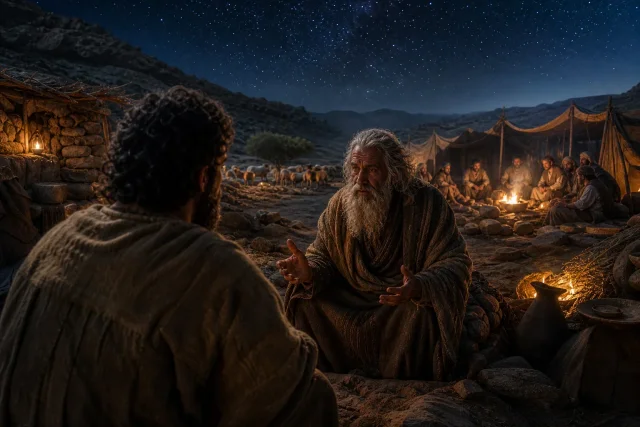
Moses at the burning bush is another type worth lingering over. He has built a life in Midian, married, worked, and settled into a quiet obscurity. Then God interrupts the ordinary with holy fire that does not consume. The Hound of Heaven is not only the One who chases the runaway. He is also the One who summons the settled, the resigned, the self-dismissed. He calls Moses back into a story larger than his private safety.
Elijah beneath the broom tree gives a different shadow. He asks to die. God does not begin with rebuke. He sends sleep, bread, water, and then a voice. This tenderness matters. Divine pursuit is not always loud storm and whale belly. Sometimes it is provision before instruction, sacramental care before prophetic commission. Between diaper changes and dishes, I have often found that grace arrives first as enough strength for the next faithful hour.
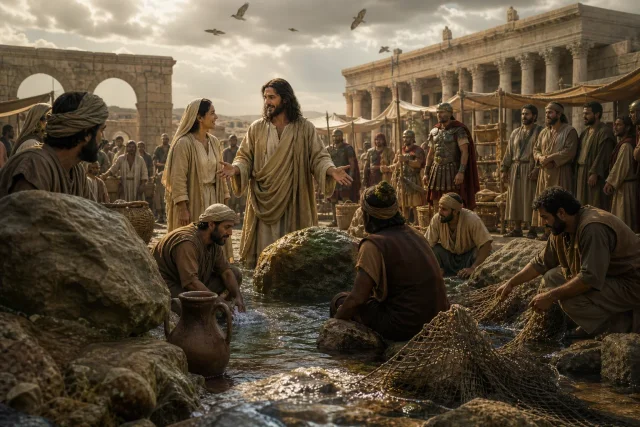
In the Gospels, Christ Himself is the fullest revelation of this pursuit. He walks toward tax collectors, demoniacs, adulterers, doubters, and grieving sisters. He calls Zacchaeus down from the tree before Zacchaeus makes a speech. He seeks the Samaritan woman at a well in the heat of day. He restores Peter beside a charcoal fire, answering the memory of denial with the patience of repeated love.
Luke 19:10 “For the Son of man came to seek and to save the lost.”
That single verse gathers the whole theme into the person of Jesus. He is the divine seeker in sandals, the covenant made flesh. Typologically, the shepherd seeking the lost sheep, the woman searching for the coin, and the father running toward the son are not disconnected moral tales. They are windows into the heart of God. They reveal a Love that moves outward, stoops low, and bears the cost of reunion.
Here’s where it gets revolutionary: suffering becomes sacred not because pain is good in itself, but because Christ has entered it and turned it into meeting ground. The cross is the place where pursuit reaches its most astonishing form. God does not merely call from a safe distance. He enters abandonment, thirst, blood, mockery, and death. Every darkness after Calvary is a darkness into which Christ has already gone. No hospital corridor, no foreclosure notice, no marriage counselor’s office, no traffic jam after a brutal appointment is untouched by His presence.
Finding Christ in the mundane means receiving this not as poetry only, but as daily bread. The woman comparing grocery totals under buzzing lights may be more closely accompanied than she feels. The father gripping the steering wheel in gridlock may be on holy ground without knowing it. The neighbor watering roses while carrying a private grief may already be standing inside a grace-filled summons.
Living Under the Footfall of Mercy
If God pursues with covenant love, then the fitting response is not frantic performance but surrender shaped by the life of the Church. I mean concrete surrender. Go to confession with specificity, not with polished vagueness. Bring the hidden resentment, the private addiction, the simmering contempt, the control, the spiritual laziness, the refusal to forgive. Grace becomes very practical in the confessional.
Prayer also changes tone. Instead of waiting to feel holy, name the truth before God with the psalmists. Pray Psalm 139 slowly. Pray Jonah from the depths. Sit before the Blessed Sacrament and let silence expose what busyness has concealed. My vocation as mother teaches me that honesty is often the first doorway to peace; children melt down less dangerously when they stop pretending they are fine, and adults are not so different.
Community matters in this, though not as a slogan. A parish meal train after surgery, a friend who drops off caldo in a foil pan, a priest who remembers your father’s name, a women’s Bible study that actually names sin and grace, these are not extras. They are the ordinary channels by which the Hound of Heaven corners us with mercy. The Church becomes the net of divine tenderness.
The saints also tutor daily practice. Ask Saint Monica to intercede for your wandering child or spouse. Ask Saint Augustine for honesty about disordered loves. Ask Our Lady, who never fled the will of God, to form in you a Marian fiat. Mary is not pursued because she is rebellious, but because she is chosen. Her yes reveals the beauty of consent when grace comes near.
I would add one more domestic practice. Mark the liturgical year in your home. Light the Advent candles even when the toddler tries to blow them out. Keep ashes visible on your forehead a little longer than feels comfortable. Place a crucifix where daily life cannot ignore it. These little material acts train the heart to live as covenant people, receiving pursuit as blessing rather than threat.
Covenant Declaration
I confess with the Church that the God who follows is the God who loves. I do not belong to accident, to panic, or to the loudest grief in the room. I belong to Jesus Christ, who sought me before I sought Him, who entered my darkness before I named it, and who keeps calling me back through Word, sacrament, saint, season, and ordinary mercy. In the midst of chaos, God whispers, and His whisper is stronger than my running.
So I pray: Lord Jesus, Hound of Heaven, pursue every corner of my heart. Hunt down what is false in me, not to shame me but to free me. Follow my family into the grocery aisle, the traffic jam, the doctor’s office, the tense dinner table, the sleepless night. Make our home a grace-filled place of surrender, and let every ordinary task become an offering within Your covenant love. Santa María, llévanos a tu Hijo.
And I speak this promise over the weary soul: the footfall behind you may be mercy already near. The darkness is not empty. Christ has entered it. The covenant still holds.
Reflection Questions
Introspective: Which area of your heart is still trying to flee the holy pursuit of God through control, distraction, resentment, or fear?
Action: What concrete act of surrender will you make this week through confession, Eucharistic adoration, a reconciliatory conversation, or a practical work of mercy for someone in crisis?
Prophetic: Where is Christ asking your family or parish to become an instrument of His pursuing love for those hiding in shame, poverty, illness, or isolation?
Continue Your Bible Study
Explore more lessons and deepen your understanding of scripture
View All Lessons Ask AI a Question