Sunday, October 18, 2026
Today we look at five sisters who stepped into a public place and asked for what was right. Their story in Numbers 27 shows advocacy with names, facts, and courage.
Today's Verse
"Then came the daughters of Zelophehad, the son of Hepher, the son of Gilead, the son of Machir, the son of Manasseh, of the families of Manasseh the son of Joseph: and these are the names of his daughters; Mahlah, Noah, and Hoglah, and Milcah, and Tirzah. And they stood before Moses, and before Eleazar the priest, and before the princes and all the congregation, by the door of the tabernacle of the congregation, saying, Our father died in the wilderness, and he was not in the company of them that gathered themselves together against the LORD in the company of Korah; but died in his own sin, and had no sons. Why should the name of our father be done away from among his family, because he hath no son? Give unto us therefore a possession among the brethren of our father. And Moses brought their cause before the LORD. And the LORD spake unto Moses, saying, The daughters of Zelophehad speak right: thou shalt surely give them a possession of an inheritance among their father's brethren; and thou shalt cause the inheritance of their father to pass unto them."— Numbers 27:1-7
Reflection
Mahlah, Noah, Hoglah, Milcah, and Tirzah did not stay silent when their father’s name and land would be lost. They stood before Moses, Eleazar, the leaders, and the whole congregation, stated the facts, and asked for a just inheritance. God said, “The daughters of Zelophehad speak right.” Advocacy often looks like this today: naming a problem clearly, showing up in the right room, and speaking for those who may be overlooked in workplaces, schools, hospitals, or families.
Advocacy is the courage to bring a real need into the open and ask for what is right with truth and persistence.
1-Minute Study: Understanding advocacy
Advocacy in Scripture is not loudness for its own sake; it is careful, truthful action on behalf of justice. The daughters of Zelophehad knew the cost of silence: their father’s name would disappear from the inheritance records. So they prepared their case, named their family line, explained their father’s situation, and made a direct request. Their advocacy was concrete, respectful, and public. This kind of courage appears elsewhere in the Bible. Esther entered the king’s presence to protect her people. The widow in Christ’s parable kept asking a judge for justice. Biblical advocacy does not wait for perfect comfort. It speaks when a policy harms, when a family member is ignored in medical decisions, when a student is treated unfairly, or when a worker is denied what is due. Advocacy begins with attention: Who is being erased, dismissed, or left out? Then it moves toward action: gather facts, speak clearly, and bring the matter before those who can act.
Cross References: Esther 4:14-16 • Luke 18:1-8 • Proverbs 31:8-9
Prayer of the Day
Lord God, You heard the daughters of Zelophehad when they stood and spoke. Teach me to notice who is being overlooked and to tell the truth with courage. Give me wisdom to advocate with clarity, respect, and steadiness. Let my words help protect the dignity and rightful place of others. Amen.
Today's Challenge
Identify one person whose concern is being overlooked this week, then help them draft a clear email, request, or appointment statement that names the issue and asks for a specific remedy.
Sacred Art Spotlight
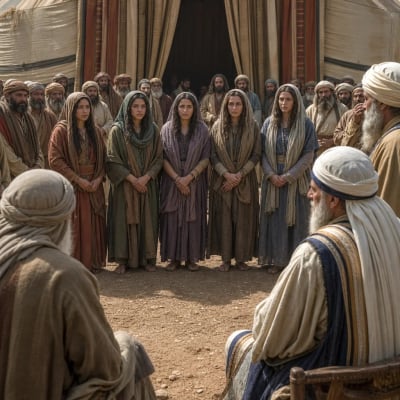
The five daughters of Zelophehad stand at the entrance of the tabernacle before Moses, Eleazar, the leaders, and the congregation, asking for their father’s inheritance.