The Synod of Dort and the Debate Over Grace and Election

The Synod of Dort and the Foundation of Grace
When Everything Falls Apart
The phone vibrates against a stack of invoices. Outside my office, cold rain strikes the windshield of a pickup, and a foreman waits for an answer: a major job has been canceled, and two workers may lose their hours. On the same desk sits a Sunday school handout about the Synod of Dort, where a dispute over grace once cost pastors their pulpits.
Financial pressure makes theological arguments sound distant until the men affected have names. One worker has a daughter facing a medical bill; another is trying to keep his mortgage current. I have faced payroll anxiety as a construction owner, and I know the temptation to treat people as numbers when the bank balance gets tight.
Dort dealt with a different crisis, but its stakes were concrete. In the Dutch Republic, arguments over election and salvation divided congregations, strained political alliances, and threatened ministers’ livelihoods. The national synod met in Dordrecht from November 1618 into May 1619, with delegates from the Dutch Reformed churches and several foreign Protestant churches.
The conflict did not begin at the synod’s door. Jacobus Arminius, a Dutch theologian who died in 1609, had challenged aspects of Reformed teaching about predestination. In 1610, his supporters presented the Remonstrance, a five article statement that became the focus of the dispute.
Those articles addressed election, Christ’s death, human inability, grace, and perseverance. The Remonstrants held that election was conditioned on faith, that Christ died for all, and that grace could be resisted. Their original statement called for further study on whether believers could fall away; it did not settle that issue.
Their opponents feared that making election conditional on foreseen faith weakened the claim that salvation rests on God’s grace. The Remonstrants feared that their opponents’ position compromised the genuine gospel invitation and made God responsible for human unbelief. Neither side treated the matter as a minor disagreement over vocabulary.
No sugar-coating this: the Bible never mentions the Synod of Dort. It was a human assembly, not a source of new revelation. Its decisions deserve serious examination under Scripture, and its treatment of opponents deserves honest historical scrutiny.
That distinction matters when a worker asks whether God cares about his family or a teenager hears that election makes prayer pointless. Before anyone reaches for a slogan, the foundation must be inspected. The actual biblical claims, the actual historical record, and the people affected all belong on the table.
Ancient Cries, Timeless Pain
Because of this, the first historical step reaches back before Dordrecht. The biblical writers faced questions about God’s rule, human responsibility, and mercy long before Dutch ministers argued over them. They did not write as detached spectators; their words came from communities marked by suffering, sin, and conflict.
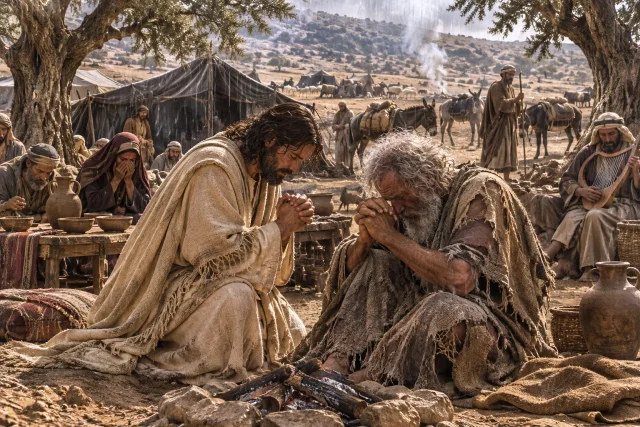
Job lost his children, possessions, and health, then sat among ashes while friends tried to explain his calamity. Their confident judgments failed to account for what they did not know. His story warns a church against assigning a hidden divine reason to every canceled contract, diagnosis, or bereavement.
David knew betrayal from within his own house, including the revolt of his son Absalom. His grief was not a denial of God’s kingship, and his prayers did not require him to pretend the danger was small. A doctrine of providence must leave room for honest lament.
Hannah wept over her barrenness and prayed at the tabernacle while Eli initially mistook her distress for drunkenness. Her account exposes the danger of judging another person’s faith from a quick look. It does not establish a rule that every prayer for a child will receive the same answer.
Paul’s argument in Romans 9 moves into a different setting: Israel’s response to the Messiah and the reliability of God’s word. He cites God’s freedom in showing mercy while addressing the place of Israel and the nations in God’s saving purpose. Dort’s defenders read the chapter as supporting unconditional election; other Christians stress its corporate and historical dimensions.
“So then it is not of him that willeth, nor of him that runneth, but of God that sheweth mercy.” Romans 9:16, KJV
The verse puts mercy, not human achievement, at the center. Its place in Paul’s argument must still be read alongside Romans 10, where the gospel is proclaimed and people are called to believe. A sound study does not cut one board from the plans and claim to have the whole building.
At Dordrecht, the delegates worked from biblical texts as well as inherited confessions. The Remonstrant representatives were summoned to present their views, but disputes over procedure ended with their dismissal from the proceedings. The synod then rejected their positions and produced the Canons of Dort.
Political power shaped that outcome. Prince Maurice backed the Contra Remonstrant cause, while his rival Johan van Oldenbarnevelt was executed in 1619 after a political trial. Remonstrant ministers were removed, and some were banished; those actions cannot be defended simply by citing a doctrine of grace.
The historical record calls for precision. Dort’s theological conclusions and the coercive measures surrounding them are related, but they are not identical. A Baptist reading can examine the arguments carefully while rejecting state enforcement of religious conformity.
The Unbreakable Promise
This changes everything: the council’s authority is ministerial, while Scripture remains the measuring line. Dort organized its response into four heads of doctrine, combining its treatment of the third and fourth Remonstrant articles. The later TULIP acronym summarizes five themes associated with the Canons; it was not the synod’s original title or arrangement.
The first head addresses election and reprobation. Dort taught that God chose particular people for salvation in Christ before the foundation of the world, not because he foresaw their faith as the condition of that choice. The Canons also affirm that God’s decree leaves others in their sin; that difficult claim must not be concealed when presenting Dort’s position.
“According as he hath chosen us in him before the foundation of the world, that we should be holy and without blame before him in love:” Ephesians 1:4, KJV
Paul locates election in Christ and connects it with holiness. Reformed readers take this passage as support for God’s unconditional choice of individuals. Other believers argue that the passage emphasizes the people chosen in Christ and dispute whether it settles the order between election and individual faith.
The second head concerns Christ’s death. Dort said his death was of infinite worth, sufficient to atone for the sins of the whole world, while teaching that God intended it effectively to save the elect. The familiar phrase “limited atonement” can obscure that distinction between the worth of Christ’s sacrifice and its intended saving effect.
Remonstrants maintained that Christ died for every person, while only believers receive forgiveness through him. Both positions need to account for the breadth of biblical gospel invitations and the actual saving work of the cross. Neither permits a preacher to withhold Christ from a listener on the assumption that the listener is not elect.
“All that the Father giveth me shall come to me; and him that cometh to me I will in no wise cast out.” John 6:37, KJV
Jesus states both the Father’s giving and his welcome to the one who comes. Reformed interpreters see a definite people given to the Son; other Christians differ over how the giving relates to faith. The promise is direct: Christ will not cast out the person who comes to him.
The combined third and fourth heads address human corruption, conversion, and grace. Dort taught that fallen people cannot turn to God by their own natural powers and that God’s renewing work effectively brings the elect to faith. The Remonstrants also affirmed the necessity of grace, but held that people can resist it.
“For by grace are ye saved through faith; and that not of yourselves: it is the gift of God: Not of works, lest any man should boast.” Ephesians 2:8–9, KJV
Paul rules out boasting in works. Christians continue to debate the precise relation between God’s gift, faith, and the human response. The passage gives no ground for treating salvation as wages earned by moral performance.
The fifth head teaches perseverance: God preserves those he has truly regenerated, though they may fall into serious sins and require repentance. Dort did not teach that a past profession makes ongoing sin harmless. Its assurance rests on God’s faithfulness and bears fruit in continued faith and obedience.
The covenant foundation runs through Scripture from God’s promise to Abraham that the nations would be blessed, to the new covenant promised in Jeremiah 31, to its fulfillment through Christ. Dort is one historical attempt to state how grace operates within that saving work. Its formulations remain accountable to the biblical text.
The Sacred Transformation
Here’s where it gets revolutionary: a church can study a contested confession without making agreement on every inference the test of Christian worth. That requires disciplined reading, not a softer view of truth. It also requires admitting when a passage says less than a system claims.
Start with John 6:35–40 and mark the Father’s giving, the Son’s reception, the call to believe, and the promise of resurrection. Read the passage aloud with the surrounding chapter before consulting a commentary. Then compare the Canons, head one, with a fair statement of the Remonstrant position.
Next, read Ephesians 1:3–14 and Ephesians 2:1–10. Note the repeated references to Christ, the description of spiritual death, and the place of good works after salvation by grace. A study group should identify the words in the text before arguing over conclusions drawn from them.
For Romans 9, keep chapters 10 and 11 open beside it. Paul speaks of God’s mercy, calls for gospel proclamation, and addresses Israel and the nations across the larger argument. Reading the whole section prevents a narrow proof text from carrying more weight than the passage can bear.
Prayer belongs in this work, but prayer is not a substitute for checking claims. Ask God for humility, then read the opposing position from its own documents. The Canons of Dort and the 1610 Remonstrance are available in English translation; a church library can help a class locate reliable editions.
Community support also has a practical shape. A pastor can tell a member facing a cancer biopsy that God is faithful without claiming to know the outcome. A church can drive that member to the appointment, bring meals, and refuse to turn the waiting room into a debate over decrees.
As a Baptist, I hold believer’s baptism and congregational responsibility dear. Dort arose in a Reformed church setting with different views of baptism and a close relationship to civil authority. Respect for its arguments does not require adopting every part of its church order or its political setting.
When I came to faith at thirty, I brought plenty of skepticism with me. I did not need a Christian to pretend every hard text was easy; I needed someone willing to open the Bible and stay with the passage. That remains a solid practice for a Sunday school room.
A useful record for the class has two columns: what the passage explicitly says and what a theological conclusion infers. Both columns matter, but they are not the same. Keep the distinction clear when discussing assurance, evangelism, and the responsibility to repent.
Living as Covenant People
At the grocery checkout, a worker counts cash twice and puts a carton of eggs back. A church member who has just studied grace can help pay without making a public display. Election is not permission to ignore the neighbor standing within reach.
On a construction crew, sound doctrine also meets payroll and safety. An owner who speaks of providence must still pay wages on time, correct a dangerous scaffold, and tell the truth about a delayed job. James 2 presses the connection between a claim of faith and action toward a person in need.
At home, a father can tell his teenagers that God’s grace is not a reward for winning a game or keeping a spotless record. He can also apologize when he has treated a missed tackle as a measure of their worth. The gospel does not excuse careless parenting; it calls for repentance and patient work.
In traffic after a hospital visit, a sharp exchange between spouses can expose how quickly fear turns into blame. A covenant promise does not settle the medical bill or excuse harsh words. It gives believers reason to pray, speak honestly, seek forgiveness, and ask their church for concrete help.
In evangelism, Dort’s own Canons call for the gospel promise to be proclaimed without distinction, with the command to repent and believe. A Baptist church should do that plainly: Christ died and rose, and sinners are called to turn to him. The preacher is not authorized to inspect God’s hidden counsel before offering the gospel.
My declaration: I will build on Christ and test every council by Scripture. Lord, keep my work honest, my speech gracious, and my confidence fixed on your promise. You have promised that the one who comes to your Son will not be cast out; keep your people faithful until he raises them at the last day.
Introspective: Where has my confidence in a theological position become an excuse for pride or indifference toward another person?
Action: This week, which passage and primary document will I read with someone who disagrees with me, and whom will I serve in a concrete way?
Prophetic: What use of religious or political power in my community needs to be challenged so that the gospel is proclaimed freely and neighbors are treated justly?
Continue Your Bible Study
Explore more lessons and deepen your understanding of scripture
View All Lessons Ask AI a Question