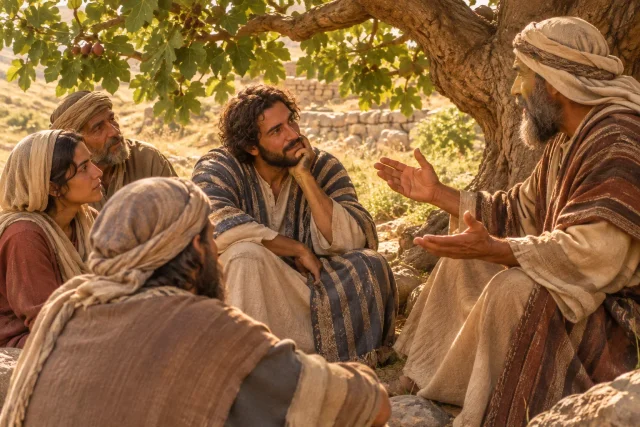
Peter Abelard and the Transforming Love of Christ

Peter Abelard and the wreckage of brilliance
Dawn on a jobsite has a way of stripping things down to what is real. Cold air bites your face. Mud sticks to your boots. A half-framed building stands against a gray sky, all studs and shadows, with a crane cable rattling in the wind and a coffee thermos steaming on the tailgate. You can tell a lot about a build before the drywall ever goes up. If the lines are off at the foundation, the whole place will fight you later.
Church history can feel that way too. You walk into it and see beams, cracks, patched walls, and some work that was flat-out impressive. Peter Abelard was one of those towering figures. Sharp mind. Fast tongue. Big reputation. He could win arguments in the schools of Paris the way a star point guard can take over a game in the fourth quarter. But when the rubber meets the road, raw brilliance is not the same thing as wisdom, and public success is not the same thing as a soul built on solid ground.
Let’s get real here. Scripture does not mention Peter Abelard by name. He lived in the twelfth century, long after the apostles. So a Bible study article about him has to do honest work. We are not asking, “What verse is about Abelard?” We are asking, “What truths from God’s Word help us weigh this man’s life, his teaching, his failures, and his impact?” That is practical. That is honest. That keeps the foundation where it belongs.
A gifted man in a hard age
Peter Abelard was born in France around 1079. He became one of the most famous teachers in medieval Europe. He studied logic, argued with leading scholars, and built a name in Paris where the cathedral schools were becoming intellectual powerhouses. Picture narrow streets, damp stone, candle smoke, crowded lecture rooms, and students packed shoulder to shoulder, listening for the next verbal hammer blow in a public debate. Abelard lived for that world.
He was not a quiet monk tucked away in a corner. He was bold, combative, and confident. Too confident, from all accounts. He challenged established teachers and built a following. One of his best-known works, Sic et Non, lined up apparently conflicting statements from earlier Christian authorities. His method pushed students to think carefully, ask hard questions, and work through tensions. There was value in that. No sugar-coating this: asking hard questions is not the enemy. Pride is.
That matters in a church setting today. I have met men on construction crews and in Sunday school classes who think faith means never asking anything difficult. That is not solid. Then I have met others who ask questions only to show everybody else how smart they are. That is not solid either. Abelard’s life warns both sides. Questions can be good tools. In the wrong hands, they become crowbars used to pry up the whole floor.
“Knowledge puffeth up, but charity edifieth.” (1 Corinthians 8:1b, KJV)
That one verse lands hard on Abelard’s story. He had knowledge in truckloads. The issue was what that knowledge was building. Was it building people up? Was it building humility? Was it building reverence before God? Here’s the bottom line: a man can be brilliant and still be spiritually crooked in key places.
The Héloïse scandal and the crash that followed
Most people who know Abelard’s name know it because of Héloïse. She was highly educated, sharp-minded, and connected to his household through her uncle Fulbert, a canon in Paris. Abelard became her tutor. That arrangement turned immoral. She became pregnant. They entered a secret marriage. The whole thing blew apart. Fulbert felt betrayed, and in a brutal act of revenge, men associated with him had Abelard attacked and castrated.
That is not a side note. It is central to the story. This was not just a theologian with abstract ideas floating over his head. This was a real man whose sin brought wreckage. Real bodies. Real shame. Real grief. Real consequences. When I talk to young men, whether on a crew or around a church table, I tell them plain: secret sin always sends the invoice later. Always.
Abelard entered monastic life after that. Héloïse also entered religious life. Their later letters are famous because they reveal deep pain, tangled loyalty, regret, and the complicated aftermath of sin mixed with affection. There is no neat movie ending here. Human love, when bent out of shape by selfishness, can leave scars that last for years. Anybody who has sat in family court, or watched a teenager carry the fallout of a dad’s choices, knows this is still current.
“Be not deceived; God is not mocked: for whatsoever a man soweth, that shall he also reap.” (Galatians 6:7, KJV)
That verse is not there to crush people who have failed. It is there because God deals in truth. Abelard sowed pride and sexual sin. He reaped public disgrace and deep suffering. At the same time, the same Bible that warns about sowing and reaping also points sinners to repentance and mercy. That tension is real. A busted foundation can sometimes be repaired, but nobody should pretend the damage was imaginary.
Why Abelard matters theologically
Now we get to the part that makes him more than a scandal story. Abelard mattered because he pushed theological ideas that shaped later discussion, especially around the atonement. In simple terms, the atonement deals with how Christ’s death saves sinners. Abelard became known for stressing the moral influence of Christ’s love. He argued that the cross chiefly moves human hearts, awakening love in us by displaying God’s love toward us.
There is a piece of truth there. The cross does reveal divine love in a staggering way. A hard man can be broken by seeing what Christ willingly endured. A proud sinner can be brought low by the sight of the innocent Son of God giving Himself. I have seen men who would not blink at blood on a jobsite tear up when they finally faced what their sin cost and what Christ did to rescue them. So we should be fair. Abelard was not wrong to say the cross changes hearts.
The problem comes when that truth is treated as the whole load-bearing wall. If the cross is only an emotional display meant to inspire us, the foundation is off. Scripture speaks of more than influence. It speaks of sacrifice, ransom, bearing sin, and reconciliation grounded in God’s justice and mercy. The Lord Jesus did not merely set an example to soften us up. He actually accomplished redemption.
“For he hath made him to be sin for us, who knew no sin; that we might be made the righteousness of God in him.” (2 Corinthians 5:21, KJV)
That verse does not read as bare sentiment. It reads as transaction, substitution, and saving action. Christ stood in the place of sinners. Building on solid ground means keeping the whole biblical witness together. God’s love is real. Christ’s example is real. The changed heart of the believer is real. But the cross also deals with guilt before a holy God. If you remove that, you have trimmed the gospel down to fit human taste.
The clash with Bernard of Clairvaux
Abelard’s trouble did not stop with personal scandal. He also collided with Bernard of Clairvaux, one of the most influential church leaders of the age. Bernard was no lightweight. He believed Abelard’s approach leaned too hard on reason and not hard enough on faithful submission to revealed truth. Their conflict became intense, public, and ugly. Abelard was eventually condemned at the Council of Sens in 1140.
Now, church history debates can get messy fast. Personalities, politics, and real doctrinal concerns all get tangled together. That happened here. Still, one issue stands out plain enough: How far can human reason go in handling the things of God? Abelard trusted logic heavily. Bernard feared that the mystery and authority of God were being dragged into a courtroom where man sat as judge.
As a Baptist, I want to say this straight. Reason is a tool. It is not the boss. God gave us minds, and Christians should think carefully. We compare Scripture with Scripture. We ask whether a teaching is sound. We reject nonsense. But we do not climb up on a stack of books and put the Lord on trial. When the rubber meets the road, revelation outranks speculation.
“Trust in the LORD with all thine heart; and lean not unto thine own understanding.” (Proverbs 3:5, KJV)
That does not mean shut your brain off. It means your brain is not the foundation. God is. Abelard’s life is a warning to every smart person in every age, including our own. A guy with three podcasts, a thousand clips online, and a crowd cheering his hot takes can still be building with rotten lumber. I have seen business owners sink because they thought being clever in a meeting meant they were wise in life. Same principle.
What Scripture helps us say about Abelard
Since the Bible does not name him, we apply biblical categories. First, Abelard illustrates the danger of pride. Second, he illustrates the damage of sexual sin. Third, he illustrates the mixed legacy a gifted person can leave. Fourth, he raises a serious question about whether our theology starts with God’s Word or with what seems most appealing to human reasoning and emotion.
James speaks to all of that with a workman’s clarity I appreciate.
“Who is a wise man and endued with knowledge among you? let him shew out of a good conversation his works with meekness of wisdom. But if ye have bitter envying and strife in your hearts, glory not, and lie not against the truth.” (James 3:13-14, KJV)
That is practical. Wisdom is not proved by winning the room. It is proved by meekness, conduct, and truth. Abelard won rooms. He did not always show meekness. A lot of men in church need that reminder. Being the loudest Bible study voice, the sharpest debater on Facebook, or the guy who can slice up everybody else’s theology does not mean you are godly. A good framer does not brag about his hammer all day. He puts up straight walls.
Paul also gives us a needed check on human boasting.
“But God hath chosen the foolish things of the world to confound the wise; and God hath chosen the weak things of the world to confound the things which are mighty.” (1 Corinthians 1:27, KJV)
That verse cuts against the celebrity-intellectual model. God is not impressed by brilliance the way universities and social media are impressed. He saves through Christ crucified. He humbles the proud. He lifts the lowly. Abelard’s era had its academic stars. Our era has conference circuits, YouTube channels, and viral clips. Same old human heart under newer lighting.
What Abelard got partly right and where he fell short
To be fair matters. Abelard pushed people to think. He resisted lazy repetition. He recognized that the love of God in Christ is not a side issue. He saw that the cross changes the inner life of the believer. Those are not small points. If a man leaves church every week untouched by the love of Christ, something is wrong with the wiring.
But here’s the bottom line. If you make the atonement mainly about our emotional response, you put the weight on the wrong beam. The gospel is first about what Christ did, not first about what we feel. Feelings matter. Love matters. Response matters. Yet sinners need more than inspiration. We need forgiveness. We need righteousness outside ourselves. We need a Savior, not just a moving example.
That is where Abelard serves as a useful caution sign in church history. He can help us ask a solid question: when we talk about Jesus, are we talking more about how He makes us feel than about what He actually accomplished? That question hits home in modern churches. Plenty of sermons can stir a room the way a locker-room speech stirs a team, but if they do not preach Christ crucified and risen as the saving work of God, the building will not stand.
Why this still matters on Tuesday morning
You may not be reading medieval theology on your lunch break. Most folks are dealing with grocery bills, blood pressure meds, a transmission light on the dash, and a teenager who answers every question with one word. Fair enough. So what does Peter Abelard have to do with real life? More than you might think.
At the grocery store, you can feel financial stress tightening your chest while you compare prices on eggs and ground beef. In traffic, somebody cuts you off and your mouth wants to outrun your character. In the neighborhood, a fence-line disagreement turns into cold silence for six months. In all those places, the issue is not medieval debate. The issue is the heart. Pride, desire, self-justification, and the need for real grace are still on the job every day.
Abelard reminds us that talent cannot save a man. Romance cannot save a man. Public respect cannot save a man. Thinking hard cannot save a man. Only Christ saves. And Christ does not save us by flattering our intellect or simply stirring our affections. He saves by His finished work, received by faith, producing a changed life. That is Baptist ground. Personal repentance. Personal faith. New birth. Then a life that starts to look different where people can actually see it.
I came to Christ as a grown man after my own years of skepticism. I had plenty of opinions and not much surrender. So I do not read Abelard from a distance, wagging my finger. I read him as a warning and a mirror. A man can be sharp and still lost in himself. A man can talk about God and still need to fall on his knees before God. That is real.
A final word on building straight
If you teach, lead, read theology, or just like a good argument, Peter Abelard is worth your time. Not because he is a safe model in every respect. He is not. He is worth your time because he forces tough questions about pride, desire, reason, doctrine, and the cross. Church history is full of cracked concrete and solid stone mixed together. Abelard is one of the places where both are easy to see.
No sugar-coating this. The Christian life is not built by brains alone. It is built on Christ. The church is not strengthened by scandal, ego, and cleverness. It is strengthened by truth, holiness, repentance, and gospel clarity. If a man’s gifts outrun his character, trouble is already in the walls.
Building on solid ground means holding fast to the full Christ of Scripture. He is the loving Savior who melts hard hearts. He is also the sin-bearing substitute who reconciles sinners to God. Hold both. Preach both. Trust both. That is a foundation that will carry weight.
Reflection questions
Contemplative: Where in your own life are you tempted to trust being sharp, capable, or respected more than being humble before Christ?
Action: What is one concrete step you need to take this week to deal honestly with pride, secret sin, or a broken relationship before the damage spreads further?
Theological: How does 2 Corinthians 5:21 keep the cross from being reduced to a mere example of love while still preserving the truth that Christ’s love changes the human heart?
Continue Your Bible Study
Explore more lessons and deepen your understanding of scripture
View All Lessons Ask AI a Question